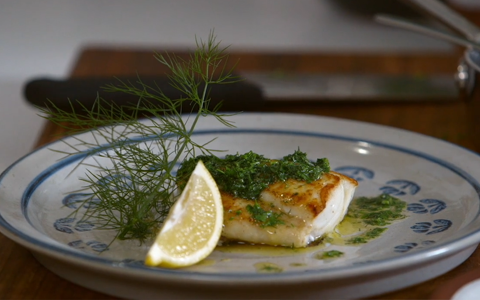
This way of cooking fish is perceived as being rather old fashioned, but if you have a really fresh fish, it can be fabulous and quite contemporary in its simplicity. Hake, cod, ling and mackerel are all delicious cooked in this way. The relish served here is classic, and when properly prepared, it will remind you why herbs, butter and lemon will always have a place at the table when fresh fish is being served.
Serves 4
4 x 120- 150g pieces of your fish of choice
2 tablespoons of flour, seasoned with salt and pepper optional
25 g butter at room temperature
salt and pepper
4 wedges of lemon
Herb Relish
50g butter
2 tablespoons of very finely chopped herbs such as parsley, chives, fennel and a few thyme leaves
black pepper
To cook the fish, place the grill pan on a medium heat and allow to become quite hot. You don’t want it smoking madly, but should see a light haze, almost like vapour, arising from the pan. Dry the fish fillets with paper towel and dip in the seasoned flour and shake off the excess. You can skip this flouring stage if you wish. With a knife, lightly butter the flesh side of the fish fillets. Place the fish, buttered sides down on the hot grill. The fish should sizzle immediately it hits the pan, if it doesn’t, the pan wasn’t hot enough and you need to crank up the heat immediately. If you have difficulty determining if the pan is hot enough, take one of the pieces of fish and holding it above the pan, just place a corner of the buttered side onto the grill. If it sizzles, it is fine to proceed, if it doesn’t then allow the pan to get hotter. Let the fish cook, still on a high heat until the fish is well coloured. There should be a bit of smoke coming from the pan, but not great clouds of it, so adjust the heat accordingly. Lift the fish at one corner to check if it is golden and getting crisp. When you are confident this stage has been reached, turn the heat down a little and with the help of a fish or egg slice, turn the fish over on to the skin side. Let it continue to cook until the skin is crispy and the fish is cooked through. You will know the fish is cooked when the flesh appears to be white and creamy in colour and no longer looks translucent.
While the fish is cooking, melt the butter for the relish. Allow the butter to cool a little before stirring in the chopped herbs.
Remove the cooked fish to hot serving plates, placing them with the golden flesh side up. Place a wedge of lemon on each plate and drizzle the herb relish over.
If you wish garnish with a spring of parsley and serve immediately.
You need to make these Christmas Cheesy Potato Stacks from @babyledfeeding 🤤 They are so good and also perfectly safe and soft enough for little babies doing baby led weaning.
Makes 24 Mini Potato Stacks Prep 15 mins Cook time 30 mins
1 kg baby potatoes 2 cloves garlic 125ml (1/2 cup) fresh cream Small handful grated gruyere cheese (plus an extra 3 tbsp) Small handful grated mozzarella 3-4 sprigs thyme leaves finely chopped Small bunch parsley leaves finely chopped 1 tsp onion powder
To serve Extra finely chopped herbs Black pepper to season
Preheat oven to 180ºC.
Thinly slice the potatoes and set aside.
Add the remaining ingredients to a bowl, leaving aside 3 tbsp of the gruyere cheese. Stir well, then add in the sliced potatoes and stir until they are fully coated. You may have to use your hands to separate the slices.
Stack the potatoes into a mini muffin tin until they are packed to the top.
Bake in the oven for 25 minutes, then remove from the oven and, top with a little sprinkle of the extra cheese. Return to the oven and bake for an additional 10 minutes until the top is golden brown. Remove from the oven and leave to cool slightly as this keeps the potato slices together.
Serve with a extra herbs and a sprinkle of fresh pepper.
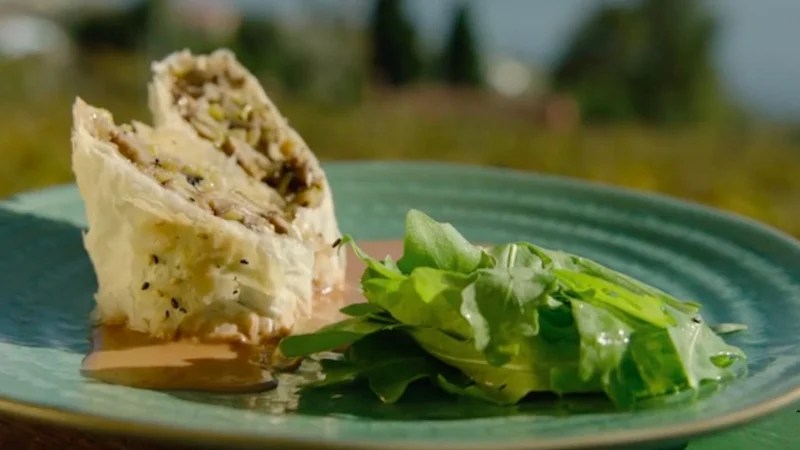
Neven Maguire’s mushroom & leek strudel with madeira wine sauce
Ingredients
Serves 4-6
For the strudel
2 tbsp olive oil, plus extra for oiling
1 small onion, peeled and finely diced
2 garlic cloves, peeled and crushed
225g mixed wild mushrooms roughly chopped
1 small leek, washed and finely sliced
2 tbsp double cream
2 tbsp Madeira Wine
2 tbsp chopped parsley
4-5 sheets filo pastry, thawed if frozen (about 100g/4oz in total)
1 egg, beaten
salt and freshly ground black pepper
mixed salad leaves, to serve
For the madeira wine sauce
700ml beef stock
1 tbsp tomato purée
3 tbsp Madeira Wine
3 tbsp cream
Method
For the strudel
Preheat the oven to 190°C/375°F/ gas mark 5.
Line a baking tray with parchment paper.
Heat the olive oil in a large frying pan.
Add the onion, garlic and mushrooms and cook over a medium to high heat for 2-3 minutes until almost tender.
Reduce the heat, add the cream and Madeira to the pan and cook for another minute.
Add herbs and salt and pepper to taste.
Sauté for another minute until the spring onions are just tender and the liquid has almost completely reduced.
Allow to cool completely.
Unroll the sheets of filo pastry and place them all, one on top of the other, on a work surface.
Brush the top sheet of pastry with beaten egg and then spread over the mushroom mixture to within 4cm (1½in) of the edges.
Fold the short ends inwards a little to meet the mushroom mixture and then, starting with a long edge, roll up the pastry fairly tightly like you would a Swiss roll, keeping the mushrooms in place as you roll.
Place the strudel seam-side down on the parchment paper and brush it all over with the remaining beaten egg.
Bake for 20-25 minutes until crisp and golden brown.
Allow to cool for a few minutes before carefully placing on a chopping board.
Cut the strudel into thick slices and arrange on warmed plates. Drizzle some sauce beside it and serve with some mixed salad leaves.
For the madeira wine sauce
Heat a heavy based saucepan, add the Madeira Wine and reduce by half.
Gradually whisk in the beef stock until smooth, followed by the tomato purée.
Simmer for approximately 5 minutes, stirring occasionally until slightly thickened.
Whisk in the cream, bring to the boil, season to taste and thicken with some diluted cornflower.
No Friday would be complete without a seriously delicious pizza. Check out how easy these gorgeous pizzas are to re-create at home (using our very own Progress Oatlets), and you’ll be making your own Italian fakeaways every Friday night. Ciao! #FlahavansOats
Serves 2 pizza bases|Takes 15 mins
Ingredients: For the Pizza Bases: 85g Progress Oats 1 large egg white ½ tsp salt Optional – 1tsp garlic powder, 1 tsp onion powder, 1tbsp grated parmesan or 1tsp nutritional yeast For the tomato topping: 400g tin chopped tomatoes 2 tbsp tomato purée 1 tsp dried mixed herbs 1 tsp honey 1 tsp sea salt flakes Couple of grinds of black pepper
Method: For the Pizza Bases: Pre-heat the oven 200C Combine the oats, egg white, salt and season in a high-speed blender and blitz for 2 minutes until completely blended. Heat a small heavy based frying pan over a medium heat. Add one tsp of vegetable oil. Spread half the oat mixture over the pan and cook for 2 minutes until the mixture firms up. Move the oat base onto a lined baking sheet and spread over the toppings and bake for 5 minutes until the pizza is cooked through
For the tomato topping:
Drain the tinned tomatoes through a sieve over a bowl, pressing with the back of a ladle until about most of the juice has drained. Tip the sieved tomatoes into a bowl and stir in the tomato purée, herbs, sugar and plenty of salt and pepper. Pour the tomato mix into a high-speed blender and blitz for 1 minute.
To serve: Basmati rice, cooked 1 red chilli, sliced (optional) 1 spring onion, sliced (optional)
Method Marinate the salmon fillets for 10 minutes before cooking. Heat a frying pan over medium heat and add in the oil. Once hot, brush most of the marinade from the salmon and cook skin side down on the pan for 3 minutes. Flip and cook for another 3 minutes. Remove from the pan and pour the remaining teriyaki sauce into the pan and cook for 2 minutes on a low heat. Meanwhile, steam or boil the broccoli until al dente. Serve the salmon on a bed of basmati rice along with the broccoli and avocado. Drizzle over with remaining sauce and garnish with chilli slices and spring onion.4d
This recipe for Bangers & Cheesy Mash from our Simply Better brand ambassador @nevenmaguire is the perfect comfort food. Find the full recipe below:
Bangers & Cheesy Mash with Caramelised Red Onion Gravy Ingredients (Serves 4) 2 Packs Simply Better Irish Pork Spring Onion & Black Pepper Sausages 2 Tubs Simply Better Irish Made Beef Gravy 3 Tbsp. Simply Better Handmade Caramelised Red Onion Relish 1 Tbsp. Simply Better Italian Extra Virgin Olive Oil 1 Tbsp. Simply Better Italian Balsamic Vinegar Steamed Greens, to serve Cheesy Mash 100g Simply Better West Cork Co-Op Extra Mature Drinagh Cheddar, grated 750g Rooster Potatoes, cut into chunks 75g Butter Method 1. Preheat the oven to 200°C (400°F/Gas Mark 6). Place the sausages on a baking tray lined with parchment paper, drizzle with the olive oil and cook in the oven for 25 minutes, turning halfway through cooking to ensure they are golden brown on all sides. 2. To make the mash, put the potatoes in a pot of cold salted water. Cover and bring to the boil, then reduce the heat and simmer for 15-20 minutes, until tender. Drain the potatoes and return to the pot over a low heat for 1-2 minutes to remove as much moisture as possible. Remove the pot from the heat, then mash with a potato masher or pass through a potato ricer until smooth. Beat in the cheese and butter and season to taste. 3. To make the gravy, heat the gravy in a saucepan over a medium heat, whisk in the caramelised red onion relish and balsamic vinegar and simmer for 2-3 minutes. 4. To serve, place a large spoonful of mash in the centre of a plate or serving bowl. Top with 3 of the roasted sausages and pour over the onion gravy. Serve with some of the steamed greens.
Reason for listing: Listed as an important example of a pre-Ecclescological Movement C19 church, retaining most of its original character.
SUMMARY
19th century church; 0% pre-19th century core fabric. On site of, and same location as, medieval church.
A single-cell church, small. Consists of chancel/nave, without structural division, 5 bays; 1841-2. Vestry (north), 1 bay, later 19th century?. Construction is in limestone rubble. Slate gable roofs, vestry with slate lean-to. Openings mainly from 1841-2, simple neo-gothic. Western bellcote, single, later 19th century.
(Box pews, west gallery and pulpit from 1841-2.)
Roofs and floors: 1841-2. Finishes: later 19th century.
Condition – good.
Archaeological potential – very good. Medium-deep external drain around 40% of church; former component beyond ?40% of church; no underfloor void; no external memorials significantly close to church.
Structural value (pre 19th century) – poor. 0% pre C19 core fabric.
Group value – low. C19 church; adjacent masonry farm buildings.
Phasing:
Phase 1 – Chancel/nave, 1841-2.
Phase 2 – Vestry (and bellcote), later C19?.
DESCRIPTION
St Mary, Nash, is a single-celled church, of small size. It was entirely rebuilt in 1841-2 on the same site, and in the same location as its predecessor, retaining none of the earlier fabric.
The present church consists of a 5-bayed chancel/nave without structural division, and a single bayed vestry north of the ‘chancel’ west bay. Construction is in limestone rubble; external pointing is largely from the later 19th century and the interior is plastered. Openings are from 1841-2 and simple neo-Gothic; the windows have 4-centred heads and 2 or 3 lights, in a simple ‘Perpendicular’ style. The west door has a 4-centred head; above it lies a parapet with a single bellcote, in darker limestone and probably an addition. The chancel/nave roof is a slated gable; the vestry has a slated lean-to roof.
Richard Fenton visited the earlier church c.1810 and described it as ‘though certainly ancient… neither has, nor appears to have had, any steeple or other ornament whatever, being the meanest religious structure I have seen in this hundred’ (Fenton, 1903, 234). It was apparently single-celled like the present church; a north aisle or chapel, ‘being grown ruinous’, had apparently been demolished a few years previously. According to Lewis, 1833, it was ‘a very ancient structure, remarkable for the rude simplicity of its architecture, and is said to have been erected by one of the earliest Norman proprietors of Upton Castle’. The tithe map of 1840 shows a conventionalised church, in elevation, with a west tower that is entirely spurious (NLW, Nash, 1840).
The church was demolished and rebuilt in its present form in 1841-2, under the local architect George Gwyther, of Pembroke Dock (Cadw, 1996, 11), and was reseated with the present pews, pulpit and gallery (Pembs. R. O., HPR/15/17); the flagged floor and plaster ceiling are contemporary. The vestry had been added by 1874 (Ordnance Survey 1:2500, First Edition, Pembs. Sheet XL.6.), when the bellcote was probably (re)built in its present form. The church was repaired in the 1890s (Cadw, 1996, 11) but the details of this work are not known.
There is a good range of internal fittings from 1841-2 including box pews, a pentagonal pulpit and a west gallery (cf. near-contemporary fittings at the nearby church at Redberth). The ‘chancel’ fittings are later 20th century (Bartosch & Stokes, 1992, 11).
The font has a square bowl which cannot be closely dated.
There is 1 bell (Bartosch & Stokes, 1992, 10).
A medium-deep external drain runs along the south wall. A north aisle/chapel was formerly present. The floor appears to lie directly on the substrate. No external memorials lie significantly close to the church.
Richard Fenton saw a medieval effigy, ‘of a crusader’, lying loose outside the church; apparently it had previously lain within the former north aisle/chapel (Fenton, 1903, 235). It has been moved to Upton Chapel (RCAHM, 1925, 253).
The church was Grade II listed in 1998.
First listed in 1970. Last amended in 1996.
Reason for listing: Listed as an important example of a pre-Ecclescological Movement C19 church, retaining most of its original character.
SITE HISTORY
There is no firm evidence for the pre-conquest religious use of the site:-
St Mary, Nash, was a parish church during the post-conquest period (Rees, 1932), of the medieval Deanery of Pembroke. It was appendant to the Manor of Nash (or ‘Esse’) and was assessed at £5 in 1291 (Green, 1913, 214). Its annual value was £6 12s 8½d in 1536 (ibid.). The chapel of Upton was subordinate to Nash parish.
Patronage was vested with the Manor of Upton and Nash in the 16th century, held by the Bowen family (ibid.), but was divided among a number of individuals by the 18th century and in 1833 was in the hands of the Rev. William Evans (Lewis, 1833), when the living was a rectory, with Upton annexed, rated in the king’s books at £6 12s 8½d (ibid.).
In 1998 St Mary, Nash, was a parish church. The living was a rectory, held with Cosheston and Upton (Benefice 583) in the Archdeaconry of St Davids, Rural Deanery of Castlemartin (St Davids, 1997-8).
The dedication is occasionally given as St Catherine (Ordnance Survey 1:2500, First and Second Editions, Pembs. Sheet XL.6.).
SOURCES CONSULTED
Map Evidence
NLW, Ordnance Survey 1:2500, First Edition, Pembs. Sheet XL.6.
NLW, Ordnance Survey 1:2500, Second Edition, Pembs. Sheet XL.6.
NLW, Parish of Nash, Tithe Map, 1840.
Rees, W., 1932, South Wales and the Border in the XIVth century.
Experiment with other flavour additions – a little chopped cooked ham or Parma ham, diced cooked mushrooms, a few herbs or some sliced artichoke heart can all go into the base before you crack in the egg. For a really extravagant addition, add a drop or two of white truffle oil over the cream.
Ingredients
Butter, for greasing
2 ripe vine tomatoes, peeled, seeded and finely chopped
4 large eggs
4 tblsp cream
25g (1oz) mature cheddar cheese, finely grated
1 tsp snipped fresh chives
Sea salt and freshly ground black pepper
Griddled sourdough bread sliced into chunky fingers, to serve
Method
Preheat the oven to 190°C (375°F/gas mark 5).
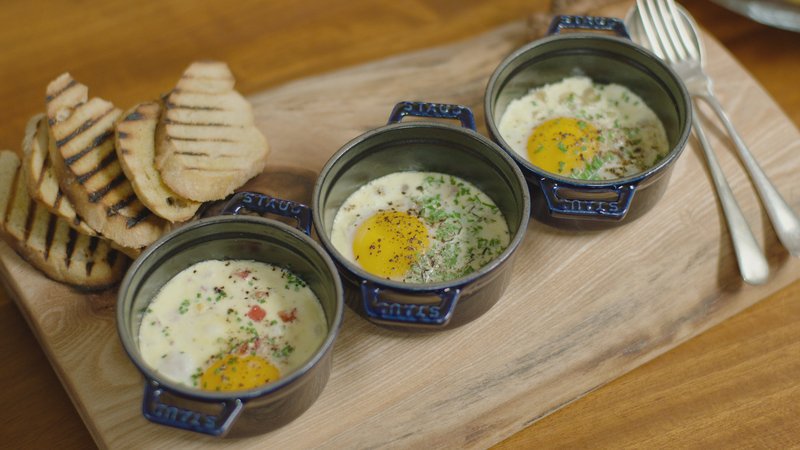
Butter 4 blini pans or ramekins and scatter the tomatoes in the bottom.
Crack an egg into each blini pan and season with salt, then add 1 tablespoon of cream to each one and scatter the cheddar on top.
Arrange the blini pans in a shallow roasting tin and pour in enough boiling water to come about halfway up the side of each pan.
Place in the oven and bake for 15 minutes, until the eggs are set and the cheese is bubbling.
Set each blini pan on a plate and scatter over the chives, then add the chunky bread fingers to serve.
#Ad | This Chicken & Sweet Potato Curry from our @simplybetterds brand ambassador @nevenmaguire is one of his most popular recipes. Our new Classic Curry Seasoning is available online and in stores now @dunnesstores
Ingredients | Serves 4
2 Tbsp Simply Better Italian Extra Virgin Olive Oil 1 Large Onion, finely chopped 1 Tbsp Freshly Grated Root Ginger 2 Tsp Simply Better Expertly Blended Garlic Flakes 2 Tbsp Simply Better Expertly Blended Classic Curry Seasoning 2 Tsp Simply Better Expertly Blended Ground Turmeric 1 Tin Simply Better Italian Chopped Tomatoes 1 Tbsp Simply Better Handmade Apricot Chutney, plus extra to serve 1 Tin Simply Better Organic Coconut Milk 750g Sweet Potatoes, peeled and cubed 2 Packs Simply Better Irish Corn Fed Chicken Thighs, cubed 1 Carton Simply Better Organic Chickpeas, drained & rinsed 4 Tbsp Simply Better Authentic Greek Yoghurt (0% fat) Fresh Coriander Sprigs Simply Better Achill Sea Salt & Freshly Ground Black Pepper Warm Simply Better Italian Piadina Romagnola IGP Alla Riminese, to serve
Method 1. Heat the oil in a large pan over a medium to high heat and sauté the onion for about 10 minutes until golden brown. Stir in the ginger and garlic flakes and cook for another minute. Add the curry powder and turmeric with a pinch of salt and continue to cook for a minute or two. 2. Add the tomatoes, apricot chutney and coconut milk to the onion and spice mixture. Stir in the sweet potatoes, then bring to a fast simmer and cover with a lid. Reduce the heat and simmer for about 20 minutes until the sweet potatoes are just tender when pierced with a sharp knife. 3. Stir in the chicken and chickpeas and cook gently for another 15 minutes until the chicken is cooked through and tender. Season to taste. 4. Divide the chicken & sweet potato curry between bowls. Add a dollop of yoghurt to each one and top with a little more chutney. Scatter over the coriander sprigs and have a basket of the warm flatbreads alongside to serve.2w