Watch Neven’s Christmas in Limerick on Thursday, 4 December on RTÉ One at 8pm.
Ingredients
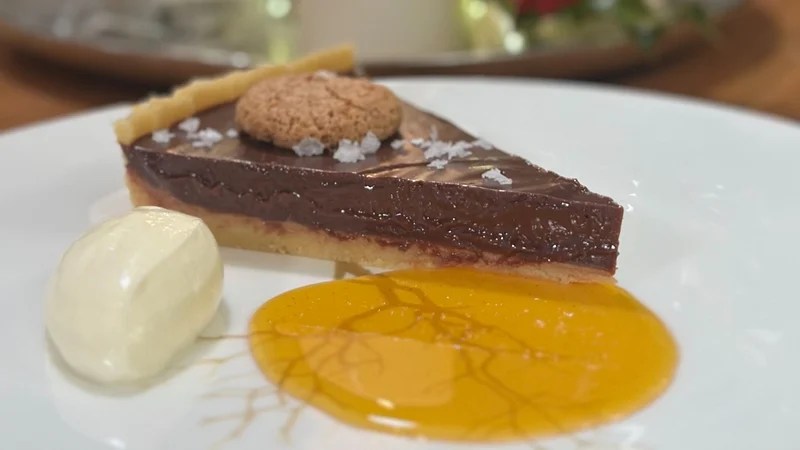
In the first of this two-part special, Neven’s Christmas in Limerick, Neven Maguire prepares Smoked Salmon Galettes, Glazed Rack of Pork with Creamy Roast Potatoes, and No-Bake Chocolate Tart.
Serves 8-10
For The Tart
300g Shortbread biscuits
150g Butter
1 Jar White Chocolate Hazelnut Spread
200g Dark Chocolate (70% cocoa solids)
100g Milk Chocolate (38% cocoa solids)
250ml Irish Jersey Cream
For The Citrus Caramel
225g caster sugar
1 tbsp glucose (liquid or powdered)
300ml orange juice
1 vanilla pod, seeds scraped out
Juice of 1 lime
Juice of 1 clementine
For Decorating
Amaretti Biscuits, to serve
Crème Fraiche, to serve
Sea Salt, to serve
Citrus Caramel, to serve
Method
For The Citrus Caramel
Place the sugar, glucose and 250ml of water into a heavy-based, high-sided pot.
Bring to the boil and then reduce the heat and simmer for 15-20 minutes until you have achieved a golden caramel colour. The sugar syrup should be a thick honey consistency, but not too runny.
Add the orange juice slowly, it will boil up vigorously, so take care at this point, whisk until the sugar has dissolved and you are left with a smooth syrup. Whisk in the vanilla seeds, lime juice and clementine juice.
Set aside and allow to cool and use as required.
For The Tart
Blitz the shortbread to a fine crumb (in a food processor or with a rolling pin and zip lock bag) and tip into a large bowl. Melt 100g of the butter in a small pan or in the microwave, then stir into the shortbread crumbs and mix until evenly combined. Press into the base and sides of a 10″ loose base tart tin.
Open the jar of white chocolate hazelnut spread into the microwave for 10-20 seconds (or you can use a pan) to loosen it up, then give it a good stir until smooth. Pour about half of the jar on to the shortbread base and use the back of a spoon to spread it out evenly. Place in the fridge to chill down.
To make the chocolate ganache, put the rest of the white chocolate hazelnut spread into a heatproof bowl along with the dark chocolate, milk chocolate and the remaining 50g of butter. Set over a pan of simmering water and allow the chocolate to melt.
In a small saucepan, gently heat the cream. Once the chocolate has melted completely add the warmed cream. Using a stick hand blender gently blend until combined and silky smooth. Pour into the prepared tart tin, place in the fridge for 2 hours until the ganache is set firm or overnight.
Remove the tart from the fridge 30 minutes before serving. To serve, carefully unmould the tart and put on a plate or cake stand, decorate with the Amaretti biscuits (if desired) cut into slices and serve with a quenelle of crème fraiche and sprinkle of sea salt.
Watch our brand ambassador @nevenmaguire prepare this delicious Ginger & Lime Baked Cheesecake. Find the full recipe below:
Ginger & Lime Baked Cheesecake with Irish Strawberry Compote Ingredients (Serves 6-8) For The Base: 2 Packs of Simply Better Handmade Oat & Ginger Cookies, crushed 75g Butter, plus extra for greasing For The Compote: 1 Bag of Simply Better Expertly Grown Frozen Irish Strawberries 250ml Simply Better Handmade Irish Raspberry & Wexford Rhubarb Cordial For the Filling: 3 Simply Better Free Range Corn Fed Large Eggs 500g Cream Cheese 100g Caster Sugar 1Tbsp Cornflour Finely Grated Rind and Juice of 2 Limes 1 Vanilla Pod, split in half lengthways and seeds scraped out To Serve: Simply Better Single Source Irish Jersey Cream, lightly whipped Method: 1. Preheat the oven to 160°C Lightly butter a 9inch loose-bottomed cake tin and line with non-stick baking or parchment paper. 2. To make the base, melt the butter in a pan set over a gentle heat. Add the crushed cookies and mix well. Spread the mixture over the base of the tin, pressing down with the back of a spoon to flatten. Place in the oven for 10 minutes to firm up. 3. Remove the tin from the oven and set aside. Place a dish of hot water in the oven on the bottom rack – this will stop a skin forming on the cheesecake. Place the cream cheese, sugar, eggs, lime rind and juice, vanilla seeds and cornflour in a mixing bowl and beat together until smooth with an electric whisk. 4. Pour this mixture into the cake tin and place on a baking sheet. Bake for 35-45 minutes until lightly golden. The filling should still be a bit wobbly at this stage. Turn off the oven, open the door and leave to cool completely. The filling will set as it cools. 5. To make the compote, place the leftover vanilla pod in a saucepan with the cordial and bring to the boil. Reduce the heat and allow to simmer for 5 minutes until reduced and slightly thickened. Place the strawberries in the pan and poach the berries for 2-3 minutes until softened but still holding their shape. Remove the vanilla pod before serving. 6. To serve, slice the cheesecake into wedges and serve with some cream and the poached strawberries.
The dressing recipe makes more than you will need, but it keeps in the fridge for a week, if covered.
For the dressing, you will need:
100ml (3½fl oz) sunflower or vegetable oil
25ml (1fl oz) extra-virgin olive oil
1 x 25g (1oz) tin of anchovies, drained and rinsed
1 egg yolk
1 small clove of garlic, peeled and crushed
1 tablespoon lemon juice
½ teaspoon Dijon mustard
Pinch of salt
½ tablespoon Worcestershire sauce
½ teaspoon Tabasco sauce
For the salad, you will need:
4 good-quality eggs
1 tablespoon sunflower oil, for frying
8 rashers of smoked streaky bacon, cut into 1cm (¼in) dice
4 handfuls of mixed lettuce leaves, including rocket and winter greens, such as baby spinach, mustard greens or beetroot leaves
50g (2oz) Parmesan cheese, grated, to serve
1 tablespoon chives, chopped, to serve
First, make the dressing – you can do this either in a food processor or by hand. First, pour the sunflower or vegetable oil, whichever you’re using, and the extra-virgin olive oil into a jug.
If you’re making the dressing by hand, mash the anchovies with a fork, then put them in a bowl along with the egg yolk, the crushed garlic, the lemon juice, the Dijon mustard, the pinch of salt, the Worcestershire sauce and the Tabasco sauce. Whisk together.
As you’re whisking, add the oil mixture from the jug very slowly and gradually. The dressing will become creamy as the emulsion forms.
When all the oil mixture has been incorporated, whisk in 25ml (1fl oz) of water to make the dressing the consistency of double cream, then add some extra seasoning to taste.
If you’re making the dressing in a food processor, add the anchovies, the egg yolk, the crushed garlic, the lemon juice, the Dijon mustard, the pinch of salt, the Worcestershire sauce and the Tabasco sauce. Whizz together, then gradually add the oil mixture from the jug and the water, as previously described, pouring them in through the machine’s feed tube.
To poach the eggs, first put a saucepan of water on a high heat and bring it to the boil.
Meanwhile, pour the sunflower oil into a frying pan on a high heat, add the bacon and fry it for 3-5 minutes, or until it is golden brown and crispy. Drain it on kitchen paper and set aside.
While the bacon is frying, tear the mixture of lettuce and winter greens into large, bite-sized pieces and place a handful on a plate. Drizzle with 1-2 tablespoons of the dressing, then sprinkle with the crispy bacon pieces.
Once the egg-poaching water has come to the boil, turn the heat down to low. Crack each egg into the lightly simmering water and poach for 3-4 minutes, or until the white is set and the yolk is still a little soft.
Turn the heat off under the saucepan and carefully lift each egg out, one by one, allowing all water to drain from the egg. Arrange one egg in the centre of each plate of dressed salad leaves, sprinkle with grated Parmesan and chopped chives.
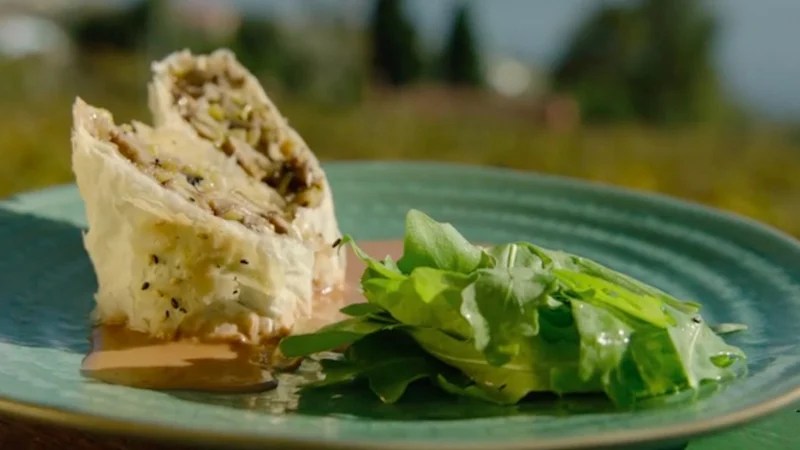
Neven Maguire’s mushroom & leek strudel with madeira wine sauce
Ingredients
Serves 4-6
For the strudel
2 tbsp olive oil, plus extra for oiling
1 small onion, peeled and finely diced
2 garlic cloves, peeled and crushed
225g mixed wild mushrooms roughly chopped
1 small leek, washed and finely sliced
2 tbsp double cream
2 tbsp Madeira Wine
2 tbsp chopped parsley
4-5 sheets filo pastry, thawed if frozen (about 100g/4oz in total)
1 egg, beaten
salt and freshly ground black pepper
mixed salad leaves, to serve
For the madeira wine sauce
700ml beef stock
1 tbsp tomato purée
3 tbsp Madeira Wine
3 tbsp cream
Method
For the strudel
Preheat the oven to 190°C/375°F/ gas mark 5.
Line a baking tray with parchment paper.
Heat the olive oil in a large frying pan.
Add the onion, garlic and mushrooms and cook over a medium to high heat for 2-3 minutes until almost tender.
Reduce the heat, add the cream and Madeira to the pan and cook for another minute.
Add herbs and salt and pepper to taste.
Sauté for another minute until the spring onions are just tender and the liquid has almost completely reduced.
Allow to cool completely.
Unroll the sheets of filo pastry and place them all, one on top of the other, on a work surface.
Brush the top sheet of pastry with beaten egg and then spread over the mushroom mixture to within 4cm (1½in) of the edges.
Fold the short ends inwards a little to meet the mushroom mixture and then, starting with a long edge, roll up the pastry fairly tightly like you would a Swiss roll, keeping the mushrooms in place as you roll.
Place the strudel seam-side down on the parchment paper and brush it all over with the remaining beaten egg.
Bake for 20-25 minutes until crisp and golden brown.
Allow to cool for a few minutes before carefully placing on a chopping board.
Cut the strudel into thick slices and arrange on warmed plates. Drizzle some sauce beside it and serve with some mixed salad leaves.
For the madeira wine sauce
Heat a heavy based saucepan, add the Madeira Wine and reduce by half.
Gradually whisk in the beef stock until smooth, followed by the tomato purée.
Simmer for approximately 5 minutes, stirring occasionally until slightly thickened.
Whisk in the cream, bring to the boil, season to taste and thicken with some diluted cornflower.
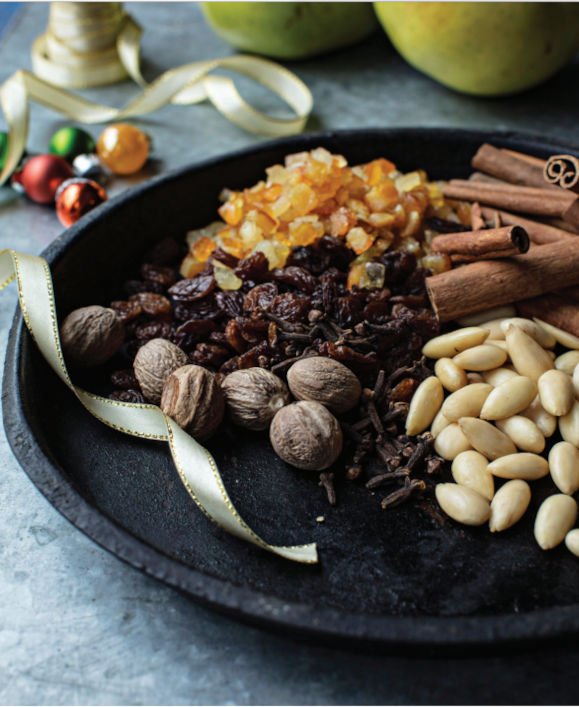
Nothing beats the flavour of homemade Christmas pudding, but it’s important to get good-quality fruit and it’s best made at least 1 month in advance.
I love plum pudding, hot or cold, with lashings of cream, but the spiked almond custard is even more special. I always look forward to it. A big thank you to Auntie Maureen for this recipe.
Ingredients
50g (2oz) plain flour
1/2 tsp ground mixed spice
1/2 tsp ground cloves
1/4 tsp ground nutmeg
225g (8oz) sultanas
175g (6oz) butter, melted, plus extra for greasing
175g (6oz) fresh white breadcrumbs
175g (6oz) light brown sugar
175g (6oz) raisins
50g (2oz) currants
50g (2oz) candied mixed peel
50g (2oz) blanched almonds, hopped
1/2 eating apple, peeled, cored and diced
1/2 small carrot, grated finely grated rind and juice of
1 lemon
2 eggs, lightly beaten
300ml (1/2 pint) stout
fresh redcurrant sprigs, to decorate (optional)
icing sugar, to decorate (optional)
spiked almond custard, to serve
Method
Sift together the flour, mixed spice, cloves and nutmeg. Add the sultanas, melted butter, breadcrumbs, sugar, raisins, currants, mixed peel, almonds, apple, carrot and the lemon rind and juice and mix until well combined. Gradually add the beaten eggs, stirring constantly, followed by the stout. Mix everything together thoroughly and cover with a clean tea towel, then leave in a cool place overnight.
Use the fruit mixture to fill 2 x 1.2 litre (2 pint) greased pudding bowls. Cover with a double thickness of greaseproof paper and tin foil, then tie tightly under the rim with string. Store in a cool, dry place overnight.
To cook, preheat the oven to 150°C (300°F/gas mark 2).
Stand each pudding basin in a large cake tin three-quarters full of boiling water, then cook in the oven for 6–8 hours (or you can steam them for 6 hours in the usual way). Cool and re-cover with clean greaseproof paper. Again, store in a cool, dry place.
On Christmas Day, re-cover with greaseproof paper and foil. Steam for 2–3 hours, until completely cooked through and tender. Decorate with the redcurrant sprigs and a light dusting of icing sugar, if liked.
To serve, cut the plum pudding into slices and arrange on serving plates. Have a separate jug of the spiked almond custard so that everyone can help themselves.
I don’t know about you but I love my bed! And I firmly believe that a good night’s sleep can make you feel so good! Breathing, eating and sleeping are three of the most basic and essential functions we do as humans. But can food affect our sleep or does our sleep affect our food? The reality is that it is probably a bit of both…On average we need between 7-9 hours’ sleep per night with some people managing on less and others may need more. Lack of sleep can lead to irritability, fatigue and difficulty concentrating. However chronic poor sleep has been linked to obesity, diabetes and heart disease.
In general, research has found that eating in line with the Mediterranean or DASH diet, both of which promote fruits and vegetables, fiber rich foods and healthy mono-unsaturated and polyunsaturated fats tends to be associated with better quality sleep. Magnesium is a mineral that is reported to help with sleep regulation and is found in bananas, nuts, green vegetables, tofu and dairy. Melatonin is a micronutrient present in some foods but also a hormone that occurs naturally in the body and helps control sleep patterns. Melatonin, is found in tart cherry juice, eggs, nuts and dairy. Interestingly the tradition of hot milk before bed comes from Roman times… and milk contains both magnesium, melatonin and an amino acid called tryptophan which helps produce serotonin and melatonin.
Kiwifruit is another food that has been reported to have a positive impact on sleep duration and quality. In one four-week trial of adults with sleep problems, consumption of two kiwifruits per day one hour before bedtime significantly increased total sleep time and sleep efficiency. A potential reason for this is that they are a rich source of antioxidant and contain the hormone serotonin. Either way they are also great sources of vitamin C and great for keeping bowel movements regular.
Do you ever feel like you make poorer food choices when you’re tired? There may be good reason behind this. Sleep deprivation can cause a drop in Leptin levels (a hormone that signals fullness) and increases the hormone Ghrelin (hormone that stimulates appetite). This change in hormones can explain why you might eat more when missing sleep or why you tend to eat more without feeling full when you have had minimal sleep. US research from Cedar- Sinai Medical Centre also found that lack of sleep increased insulin resistance. So, we can see that regular good night sleep helps manage hormones, appetite and possible food choices.
Caffeine and alcohol can negatively affect falling asleep and sleep quality so best to keep within healthy limits if struggling with sleep. Maybe keep the caffeine to before midday!
2 tbsp extra virgin olive oil, plus a little extra, if liked
500ml (18fl oz) boiling water
75g (3oz) rice flour
1 tbsp sumac, plus extra to garnish
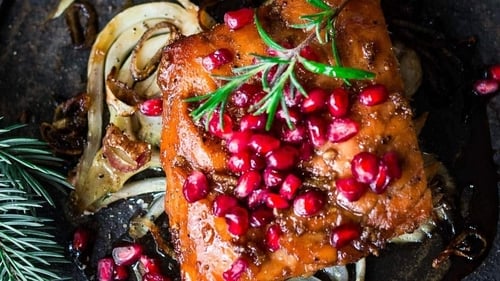
150g (5oz) organic salmon fillets, pin-boned and skinned
75g (3oz) toasted pumpkin seeds
2 tbsp flax seeds finely grated rind of 1 lemon
2 large handfuls of watercress
1 small pomegranate, halved and seeds removed (skin discarded)
lemon wedges, to garnish
HARISSA YOGHURT:
2 heaped tbsp thick Greek yoghurt
2 tsp harissa paste
sea salt and freshly ground black pepper
Method
Neven Says: “This is a super-healthy dish packed full of omega-3. Sumac is made from the dried berries of a flowering plant that are ground to produce an acidic, reddish- purple powder that is very popular in the Middle East.
Place the couscous in a heatproof bowl and season well, then stir in 1 teaspoon of the oil. Pour over the boiling water, cover tightly with cling film and set aside.
Heat the rest of the olive oil in a large non-stick frying pan over a medium to high heat. Put the rice flour in a shallow dish with the sumac and season generously with salt and pepper. Dust the salmon in the flour mixture, shaking off any excess. Add to the heated oil in the frying pan and cook for 2–3 minutes on each side, until crisp and golden.
Meanwhile, fluff up the couscous with a fork, then fold in the pumpkin seeds and flaxseeds with the lemon rind. At the last moment, roughly chop the watercress and toss it through the couscous with the pomegranate seeds.
Mix the yoghurt and harissa together in a small bowl and season to taste. Cover with cling film and chill until needed.
Arrange the crispy salmon on plates and add an extra light sprinkling of sumac. Add a small mound of the couscous, then drizzle over a little extra olive oil, if liked. Garnish with lemon wedges and add a spoonful of the harissa yoghurt to serve.
Butternut squash risotto is a delightful and nutritious dish that combines the creamy texture of traditional risotto with the wholesome goodness of brown sushi rice and a medley of vibrant vegetables. Perfect for a cozy dinner or a special occasion, enjoy a hearty and healthy meal that will leave you feeling satisfied and nourished.
Servings: 6 Serving Size: ¾ cup
Nutritional Information Per Serving
171 calories
5 g total fat
3 g saturated fat
0 g transfat
0 g monounsaturated fat
13 mg cholesterol
362 mg sodium
24 g total carbohydrate
3 g dietary fiber
4 g total sugars
8 g protein
Ingredients
½ cup uncooked brown sushi rice
1 teaspoon olive oil
1 cup diced onion
4 cups low-sodium chicken stock
1 cup white wine
2 cups roasted butternut squash, chopped
1 cup chopped zucchini
½ cup frozen peas
5 chopped crimini mushrooms
1 tablespoon chopped sage
1 teaspoon chopped thyme
½ cup shredded Asiago cheese
1 tablespoon heavy cream
½ teaspoon kosher salt
½ teaspoon ground black pepper
Directions
Follow package directions to partially cook the rice for about 40 minutes. Drain excess water and set aside.
Preheat a medium sauté pan to medium-high heat and add olive oil.
Add the onions and sauté until soft.
Add the rice to the pan and sauté with the onions for about 2 minutes, stirring continuously.
Reserve 1/2 cup of stock. Then pour 1/2 cup of stock into sauté pan and let it absorb into the rice.
Stir in 1/2 cup of wine and let it absorb into the rice.
Continue adding stock and wine in 1/2-cup increments, cooking each time until the liquid is absorbed before adding more, about 30 to 45 minutes total.
Add the squash, zucchini, peas, mushrooms, sage and thyme to the pan, and cook until the vegetables are soft, about 3 to 5 minutes.
Add the last 1/2 cup of the stock. Once the stock is absorbed into the rice, add the cheese, cream, salt and pepper; stir well.
Dietitian’s tip:
Traditional risotto is made with uncooked white rice. Brown rice adds fiber and nutrients, but it takes a long time to make risotto this way. That’s why this recipe calls for partially cooking the rice.
1 packet of shortcrust pastrythawed if bought frozen
1 tbsp flour
1 eggbeaten
Handful flaked almonds
Directions
1
Place raspberries in a medium sized bowl then sprinkled over caster sugar and squeeze over some lemon juice. Stir with a fork so that some of the raspberries are broken up, but still maintaining plenty of whole ones. Set aside.
2
Pre-heat the oven to 200°C / 180°C fan assisted and place a flat baking sheet or overturned tray in the oven to pre-heat.
3
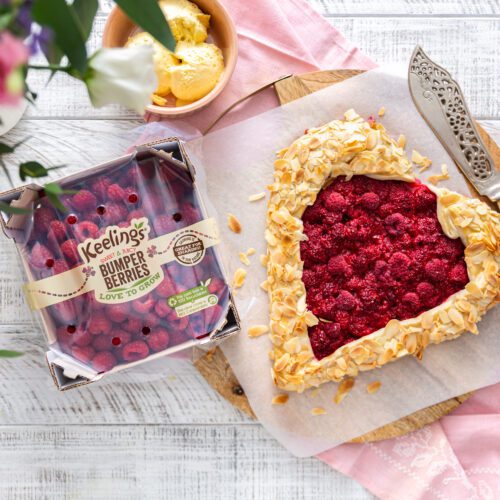
Roll out chilled shortcrust pastry on a floured surface to about 5mm thick then transfer to a baking tray lined with parchment paper. Using a sharp knife, cut the pastry into a large heart, discarding the trimmed pieces of pastry.
4
Sprinkle the flour over the middle of the pastry, this will help thicken the juices while baking, then tip out the raspberries on top and spread out over the pastry in an even layer, but keep a 4-5cm border around the edges.
5
Fold the pastry border up and over the filling, shaping the galette into a heart as you fold the edges over, until you’re back where you started, crimping the pastry together where the folds meet to help them stick.
6
Brush the pastry border with beaten egg and sprinkle with flaked almonds.
7
Place the tray directly on top of the hot tray already in the oven and bake until pastry is golden, 30-35 minutes.
8
Remove from the oven and leave to stand for about 5-10 minutes before serving with scoops of ice-cream or dollops of whipped cream while still warm.
Reason for listing: Listed as an important example of a pre-Ecclescological Movement C19 church, retaining most of its original character.
SUMMARY
19th century church; 0% pre-19th century core fabric. On site of, and same location as, medieval church.
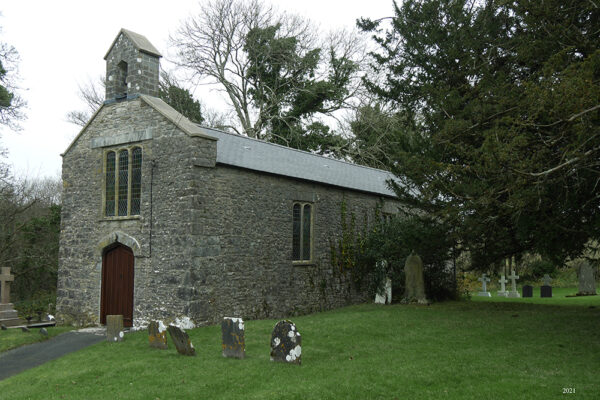
A single-cell church, small. Consists of chancel/nave, without structural division, 5 bays; 1841-2. Vestry (north), 1 bay, later 19th century?. Construction is in limestone rubble. Slate gable roofs, vestry with slate lean-to. Openings mainly from 1841-2, simple neo-gothic. Western bellcote, single, later 19th century.
(Box pews, west gallery and pulpit from 1841-2.)
Roofs and floors: 1841-2. Finishes: later 19th century.
Condition – good.
Archaeological potential – very good. Medium-deep external drain around 40% of church; former component beyond ?40% of church; no underfloor void; no external memorials significantly close to church.
Structural value (pre 19th century) – poor. 0% pre C19 core fabric.
Group value – low. C19 church; adjacent masonry farm buildings.
Phasing:
Phase 1 – Chancel/nave, 1841-2.
Phase 2 – Vestry (and bellcote), later C19?.
DESCRIPTION
St Mary, Nash, is a single-celled church, of small size. It was entirely rebuilt in 1841-2 on the same site, and in the same location as its predecessor, retaining none of the earlier fabric.
The present church consists of a 5-bayed chancel/nave without structural division, and a single bayed vestry north of the ‘chancel’ west bay. Construction is in limestone rubble; external pointing is largely from the later 19th century and the interior is plastered. Openings are from 1841-2 and simple neo-Gothic; the windows have 4-centred heads and 2 or 3 lights, in a simple ‘Perpendicular’ style. The west door has a 4-centred head; above it lies a parapet with a single bellcote, in darker limestone and probably an addition. The chancel/nave roof is a slated gable; the vestry has a slated lean-to roof.
Richard Fenton visited the earlier church c.1810 and described it as ‘though certainly ancient… neither has, nor appears to have had, any steeple or other ornament whatever, being the meanest religious structure I have seen in this hundred’ (Fenton, 1903, 234). It was apparently single-celled like the present church; a north aisle or chapel, ‘being grown ruinous’, had apparently been demolished a few years previously. According to Lewis, 1833, it was ‘a very ancient structure, remarkable for the rude simplicity of its architecture, and is said to have been erected by one of the earliest Norman proprietors of Upton Castle’. The tithe map of 1840 shows a conventionalised church, in elevation, with a west tower that is entirely spurious (NLW, Nash, 1840).
The church was demolished and rebuilt in its present form in 1841-2, under the local architect George Gwyther, of Pembroke Dock (Cadw, 1996, 11), and was reseated with the present pews, pulpit and gallery (Pembs. R. O., HPR/15/17); the flagged floor and plaster ceiling are contemporary. The vestry had been added by 1874 (Ordnance Survey 1:2500, First Edition, Pembs. Sheet XL.6.), when the bellcote was probably (re)built in its present form. The church was repaired in the 1890s (Cadw, 1996, 11) but the details of this work are not known.
There is a good range of internal fittings from 1841-2 including box pews, a pentagonal pulpit and a west gallery (cf. near-contemporary fittings at the nearby church at Redberth). The ‘chancel’ fittings are later 20th century (Bartosch & Stokes, 1992, 11).
The font has a square bowl which cannot be closely dated.
There is 1 bell (Bartosch & Stokes, 1992, 10).
A medium-deep external drain runs along the south wall. A north aisle/chapel was formerly present. The floor appears to lie directly on the substrate. No external memorials lie significantly close to the church.
Richard Fenton saw a medieval effigy, ‘of a crusader’, lying loose outside the church; apparently it had previously lain within the former north aisle/chapel (Fenton, 1903, 235). It has been moved to Upton Chapel (RCAHM, 1925, 253).
The church was Grade II listed in 1998.
First listed in 1970. Last amended in 1996.
Reason for listing: Listed as an important example of a pre-Ecclescological Movement C19 church, retaining most of its original character.
SITE HISTORY
There is no firm evidence for the pre-conquest religious use of the site:-
St Mary, Nash, was a parish church during the post-conquest period (Rees, 1932), of the medieval Deanery of Pembroke. It was appendant to the Manor of Nash (or ‘Esse’) and was assessed at £5 in 1291 (Green, 1913, 214). Its annual value was £6 12s 8½d in 1536 (ibid.). The chapel of Upton was subordinate to Nash parish.
Patronage was vested with the Manor of Upton and Nash in the 16th century, held by the Bowen family (ibid.), but was divided among a number of individuals by the 18th century and in 1833 was in the hands of the Rev. William Evans (Lewis, 1833), when the living was a rectory, with Upton annexed, rated in the king’s books at £6 12s 8½d (ibid.).
In 1998 St Mary, Nash, was a parish church. The living was a rectory, held with Cosheston and Upton (Benefice 583) in the Archdeaconry of St Davids, Rural Deanery of Castlemartin (St Davids, 1997-8).
The dedication is occasionally given as St Catherine (Ordnance Survey 1:2500, First and Second Editions, Pembs. Sheet XL.6.).
SOURCES CONSULTED
Map Evidence
NLW, Ordnance Survey 1:2500, First Edition, Pembs. Sheet XL.6.
NLW, Ordnance Survey 1:2500, Second Edition, Pembs. Sheet XL.6.
NLW, Parish of Nash, Tithe Map, 1840.
Rees, W., 1932, South Wales and the Border in the XIVth century.