Bring a pan of water to the boil, add the potatoes and cook for 10 minutes until par-boiled, not fully cooked through. Remove and allow to cool whilst you prepare the rest of the dish.
Combine the sausagemeat, hazelnuts and parsley in a bowl and mix thoroughly.
Divide the sausagemeat filling between the pockets in each chicken breast. Season the chicken with a pinch of salt and roll each chicken breast in 3 slices of pancetta. Place the chicken breasts on a baking tray and bake for 10–15 minutes, depending on the thickness of the breast. When the chicken is cooked through, remove from the oven and rest for 5 minutes.
Grate the par-boiled potatoes on a box grater. Meanwhile, put a large frying pan over a medium-high heat. Add the olive oil, then the grated potato, garlic powder, onion powder and a pinch of salt and fry until golden.
In a separate pan, melt the butter and add the garlic and sage leaves. Fry until the leaves are wilted, then add the mushrooms and a pinch of salt. Cook for 1–2 minutes until golden.
Add the chicken stock and reduce to a sauce consistency. You can add an extra knob of butter to finish the sauce, if you like.
To serve, place the fried potato on a serving plate. Carve the chicken and arrange on top, finishing with the mushroom sauce.
My brother, Kenneth, loves Asian food and he is in no doubt that he is far better than me at cooking it! I don’t disagree. He is proud of this chicken satay dish and often makes it for the family. This dipping sauce also works well with pork, prawns, beef strips or turkey. And remember, kids just love anything on sticks!
SERVES 4
4 tbsp dark soy sauce
2 tsp clear honey
2 tsp medium curry powder
450g (1lb) skinless chicken breast fillets, cut into long strips
FOR THE PICKLED CUCUMBER SALAD:
4 tbsp rice wine vinegar
2 tbsp caster sugar
pinch of salt
½ small cucumber, peeled, halved, deseeded and thinly sliced
FOR THE DIPPING SAUCE:
2 tbsp crunchy peanut butter
2 tsp dark soy sauce
1 tsp light brown sugar
juice of ½ lime
1 x 160ml (5½fl oz) tin of coconut milk (Thai Gold, if possible)
½ red chilli, deseeded and finely diced
2 tbsp chopped fresh coriander
sea salt and freshly ground black pepper
1 To make the dipping sauce, place the peanut butter in a small pan and stir in the soy sauce, light brown sugar and lime juice. Gradually whisk in the coconut milk and heat gently until you have achieved a smooth sauce. Stir in the chilli and coriander, then leave to cool, stirring occasionally to prevent a skin from forming.
2 Soak 8 x 15cm (6in) bamboo skewers in a shallow dish of cold water for at least 30 minutes. Preheat a griddle pan until it’s smoking hot or light a barbecue.
3 Whisk together the soy sauce, honey and curry powder. Season with pepper and stir in the chicken pieces. Leave to marinate for 2 minutes, then thread the chicken pieces onto the soaked bamboo skewers and arrange on the barbecue. Cook the chicken skewers over medium-hot coals for 4–6 minutes, turning once or twice, until completely tender and cooked through. If using a griddle pan, reduce the heat to medium as soon as you’ve put the skewers on.
4 Meanwhile, to prepare the pickled cucumber salad, place the vinegar in a bowl and stir in the sugar and a good pinch of salt until both have dissolved. Tip in the cucumber, stirring to combine, and set aside to allow the flavours to develop. 5 To serve, arrange 2 chicken satay skewers on each warmed plate. Divide the dipping sauce among individual bowls and place to the side of the skewers. Add the pickled cucumber salad, leaving behind any excess liquid, to serve.
Butter Chicken
Swap your usual takeaway curry for this homemade chicken makhana, which combines marinated chicken with a rich, buttery sauce. This is an authentic Indian curry with its origins in Delhi, where it was first made to use up pieces of leftover tandoori chicken.
Serves 4–6
500g skinless and boneless chicken breasts or thighs
juice and finely grated rind of 1 lemon
3 tbsp mild curry seasoning
4 tbsp natural yogurt
3 tbsp sunflower oil
30g butter
2 red onions, thinly sliced
2 garlic cloves, sliced
1 red chilli, seeded
3cm piece fresh root ginger, peeled and sliced
20g fresh coriander
400ml passata (Italian sieved tomatoes)
120ml cream
sea salt and freshly ground black pepper
Trim the chicken and cut into bite-sized pieces. Put in a bowl and stir in half the lemon juice with a good pinch of salt. Add 2 tablespoons of the curry seasoning, the yogurt and 1 tablespoon of the oil. Mix to combine, then season generously with pepper. Cover and leave to marinate for at least 1 hour or up to 3 days in the fridge.
Heat the rest of the oil and a knob of the butter in a wok or skillet over a high heat, and quickly sear the marinated chicken in batches until golden brown, transferring with a slotted spoon to a clean bowl as you go. Add the onions to the pan and sauté for 4–5 minutes until they start to caramelise.
Tip in the garlic, chilli and ginger, then add another knob of the butter and sauté for 1–2 minutes. Chop the stalks from the coriander and add them to the pan with the rest of the curry seasoning and another knob of the butter. Toast for a few minutes until very fragrant. Pour the passata into the pan and bring to a simmer, then add the cream and the rest of the lemon juice.
Transfer to a blender and blend until you have a very smooth sauce. Return to the pan and add the chicken with any juices and reheat gently for about 5 minutes until the chicken is cooked through and tender. Season to taste, then fold in the lemon rind with the rest of the butter and the coriander leaves, reserving a few sprigs to garnish. Transfer to bowls and garnish with the coriander sprigs.
SERVE WITH … This mild and creamy curry is sure to please all tastes. Make some Homemade Flatbreads, perhaps brushing them with a little melted butter and sprinkling with black onion seeds. A bowl of Pilau Rice completes the meal, alongside some spiced mango chutney, mint raita and lime pickle.
The dressing recipe makes more than you will need, but it keeps in the fridge for a week, if covered.
For the dressing, you will need:
100ml (3½fl oz) sunflower or vegetable oil
25ml (1fl oz) extra-virgin olive oil
1 x 25g (1oz) tin of anchovies, drained and rinsed
1 egg yolk
1 small clove of garlic, peeled and crushed
1 tablespoon lemon juice
½ teaspoon Dijon mustard
Pinch of salt
½ tablespoon Worcestershire sauce
½ teaspoon Tabasco sauce
For the salad, you will need:
4 good-quality eggs
1 tablespoon sunflower oil, for frying
8 rashers of smoked streaky bacon, cut into 1cm (¼in) dice
4 handfuls of mixed lettuce leaves, including rocket and winter greens, such as baby spinach, mustard greens or beetroot leaves
50g (2oz) Parmesan cheese, grated, to serve
1 tablespoon chives, chopped, to serve
First, make the dressing – you can do this either in a food processor or by hand. First, pour the sunflower or vegetable oil, whichever you’re using, and the extra-virgin olive oil into a jug.
If you’re making the dressing by hand, mash the anchovies with a fork, then put them in a bowl along with the egg yolk, the crushed garlic, the lemon juice, the Dijon mustard, the pinch of salt, the Worcestershire sauce and the Tabasco sauce. Whisk together.
As you’re whisking, add the oil mixture from the jug very slowly and gradually. The dressing will become creamy as the emulsion forms.
When all the oil mixture has been incorporated, whisk in 25ml (1fl oz) of water to make the dressing the consistency of double cream, then add some extra seasoning to taste.
If you’re making the dressing in a food processor, add the anchovies, the egg yolk, the crushed garlic, the lemon juice, the Dijon mustard, the pinch of salt, the Worcestershire sauce and the Tabasco sauce. Whizz together, then gradually add the oil mixture from the jug and the water, as previously described, pouring them in through the machine’s feed tube.
To poach the eggs, first put a saucepan of water on a high heat and bring it to the boil.
Meanwhile, pour the sunflower oil into a frying pan on a high heat, add the bacon and fry it for 3-5 minutes, or until it is golden brown and crispy. Drain it on kitchen paper and set aside.
While the bacon is frying, tear the mixture of lettuce and winter greens into large, bite-sized pieces and place a handful on a plate. Drizzle with 1-2 tablespoons of the dressing, then sprinkle with the crispy bacon pieces.
Once the egg-poaching water has come to the boil, turn the heat down to low. Crack each egg into the lightly simmering water and poach for 3-4 minutes, or until the white is set and the yolk is still a little soft.
Turn the heat off under the saucepan and carefully lift each egg out, one by one, allowing all water to drain from the egg. Arrange one egg in the centre of each plate of dressed salad leaves, sprinkle with grated Parmesan and chopped chives.
The dressing recipe makes more than you will need, but it keeps in the fridge for a week, if covered.
For the dressing, you will need:
100ml (3½fl oz) sunflower or vegetable oil
25ml (1fl oz) extra-virgin olive oil
1 x 25g (1oz) tin of anchovies, drained and rinsed
1 egg yolk
1 small clove of garlic, peeled and crushed
1 tablespoon lemon juice
½ teaspoon Dijon mustard
Pinch of salt
½ tablespoon Worcestershire sauce
½ teaspoon Tabasco sauce
For the salad, you will need:
4 good-quality eggs
1 tablespoon sunflower oil, for frying
8 rashers of smoked streaky bacon, cut into 1cm (¼in) dice
4 handfuls of mixed lettuce leaves, including rocket and winter greens, such as baby spinach, mustard greens or beetroot leaves
50g (2oz) Parmesan cheese, grated, to serve
1 tablespoon chives, chopped, to serve
First, make the dressing – you can do this either in a food processor or by hand. First, pour the sunflower or vegetable oil, whichever you’re using, and the extra-virgin olive oil into a jug.
If you’re making the dressing by hand, mash the anchovies with a fork, then put them in a bowl along with the egg yolk, the crushed garlic, the lemon juice, the Dijon mustard, the pinch of salt, the Worcestershire sauce and the Tabasco sauce. Whisk together.
As you’re whisking, add the oil mixture from the jug very slowly and gradually. The dressing will become creamy as the emulsion forms.
When all the oil mixture has been incorporated, whisk in 25ml (1fl oz) of water to make the dressing the consistency of double cream, then add some extra seasoning to taste.
If you’re making the dressing in a food processor, add the anchovies, the egg yolk, the crushed garlic, the lemon juice, the Dijon mustard, the pinch of salt, the Worcestershire sauce and the Tabasco sauce. Whizz together, then gradually add the oil mixture from the jug and the water, as previously described, pouring them in through the machine’s feed tube.
To poach the eggs, first put a saucepan of water on a high heat and bring it to the boil.
Meanwhile, pour the sunflower oil into a frying pan on a high heat, add the bacon and fry it for 3-5 minutes, or until it is golden brown and crispy. Drain it on kitchen paper and set aside.
While the bacon is frying, tear the mixture of lettuce and winter greens into large, bite-sized pieces and place a handful on a plate. Drizzle with 1-2 tablespoons of the dressing, then sprinkle with the crispy bacon pieces.
Once the egg-poaching water has come to the boil, turn the heat down to low. Crack each egg into the lightly simmering water and poach for 3-4 minutes, or until the white is set and the yolk is still a little soft.
Turn the heat off under the saucepan and carefully lift each egg out, one by one, allowing all water to drain from the egg. Arrange one egg in the centre of each plate of dressed salad leaves, sprinkle with grated Parmesan and chopped chives.
First season the haddock pieces with the salt and freshly ground black pepper. Arrange the fillets in a single layer in the ovenproof dish (it should be a dish that is posh enough to bring to the table). Mix the grated Cheddar cheese together with the Dijon mustard and the cream and spread carefully over the fish.
The fish can be prepared ahead and refrigerated at this point. It will keep in the fridge for a day.
To cook, place in the pre-heated oven for about 20 minutes or until the fish is cooked and the top is golden and bubbly. If the fish is cooked but the top is not yet golden, place under a hot grill for just a few moments to colour the cheese.
Of course this recipe is great with just parsley but experiment with a combination of soft fragrant herbs sauce as parsley, chives, tarragon or chervil depending on what’s available.
Serves 4
Ingredients
4 x 175g hake fillets, skin on and boned
1 tablesp. olive oil
Salt and freshly ground pepper
50g butter
½ lemon, pips removed
1 tablesp. chopped mixed herbs (parsley, chives and tarragon)
To Cook
Heat the olive oil in a large frying pan and add the seasoned hake fillets, skin side down. Cook for a couple of minutes until the skin is just beginning to crisp, then add little knobs of butter to the pan around each hake fillet and cook for another couple of minutes until the skin is crisp.
Turn the hake fillets over and cook for another 3-4 minutes until cooked through. This will depend on the thickness of the fillets. Transfer to warmed plates while you make the sauce.
Add the rest of the butter to the frying pan and allow it to gently melt over a moderate heat. When it has melted, add a squeeze of lemon juice and the herbs, swirling to combine. Season to taste. Spoon this sauce over the hake fillets and serve with steamed broccoli and some sautéed new potatoes.
Serving Suggestions
Steamed broccoli and sauté new potatoes
Tips
Above all be careful not to overcook the fish. To check, gently prod the thickest part of the fish with a small knife. If it is cooked, the flesh will look opaque and the flakes will separate easily. If it isn’t done yet, it will still have the translucent look for raw fish.
Other fish you could use: Whiting, haddock or trout fillets
I’m a big country music fan and I love cooking!! So, when I saw Trisha Yearwood had a new cookbook, I had to give it a try!
You can tell that Trisha has put a lot of heart and soul into this cookbook. She shares family recipes and stories throughout. Trisha has a way of making you feel like you are a guest at her dinner table. By the end, you feel like you know, not only her better, but others in her family.
The recipes did not disappoint. As always, when I do a cookbook review, I had to try some of the recipes so I could genuinely rate the cookbook. There is a little something for everyone with 125 recipes that cover everything from breakfast, snacks, pork & beef, chicken, turkey & fish, etc. I made Company Chicken and PB&J Cookie Bars. What I love about the book is that it doesn’t call for a bunch of fancy ingredients, and I had everything on hand to make these two recipes. The Company Chicken was very flavorful and something easy that I will be able to make for guests. The PB&J Cookie Bars have become a fast breakfast in my household and are also super easy to make.
Keep in mind that most of the recipes are southern-inspired comfort food so, if you want to make the recipes healthier, you may have to make some ingredient substitutions.
QOTD: Do you have a favorite celebrity cookbook? If not, what’s your favorite dish to cook?
Do you like country music? Who’s your favorite singer/group?
My brother, Kenneth, loves Asian food and he is in no doubt that he is far better than me at cooking it! I don’t disagree. He is proud of this chicken satay dish and often makes it for the family. This dipping sauce also works well with pork, prawns, beef strips or turkey. And remember, kids just love anything on sticks!
SERVES 4
4 tbsp dark soy sauce
2 tsp clear honey
2 tsp medium curry powder
450g (1lb) skinless chicken breast fillets, cut into long strips
FOR THE PICKLED CUCUMBER SALAD:
4 tbsp rice wine vinegar
2 tbsp caster sugar
pinch of salt
½ small cucumber, peeled, halved, deseeded and thinly sliced
FOR THE DIPPING SAUCE:
2 tbsp crunchy peanut butter
2 tsp dark soy sauce
1 tsp light brown sugar
juice of ½ lime
1 x 160ml (5½fl oz) tin of coconut milk (Thai Gold, if possible)
½ red chilli, deseeded and finely diced
2 tbsp chopped fresh coriander
sea salt and freshly ground black pepper
1 To make the dipping sauce, place the peanut butter in a small pan and stir in the soy sauce, light brown sugar and lime juice. Gradually whisk in the coconut milk and heat gently until you have achieved a smooth sauce. Stir in the chilli and coriander, then leave to cool, stirring occasionally to prevent a skin from forming.
2 Soak 8 x 15cm (6in) bamboo skewers in a shallow dish of cold water for at least 30 minutes. Preheat a griddle pan until it’s smoking hot or light a barbecue.
3 Whisk together the soy sauce, honey and curry powder. Season with pepper and stir in the chicken pieces. Leave to marinate for 2 minutes, then thread the chicken pieces onto the soaked bamboo skewers and arrange on the barbecue. Cook the chicken skewers over medium-hot coals for 4–6 minutes, turning once or twice, until completely tender and cooked through. If using a griddle pan, reduce the heat to medium as soon as you’ve put the skewers on.
4 Meanwhile, to prepare the pickled cucumber salad, place the vinegar in a bowl and stir in the sugar and a good pinch of salt until both have dissolved. Tip in the cucumber, stirring to combine, and set aside to allow the flavours to develop. 5 To serve, arrange 2 chicken satay skewers on each warmed plate. Divide the dipping sauce among individual bowls and place to the side of the skewers. Add the pickled cucumber salad, leaving behind any excess liquid, to serve.
Butter Chicken
Swap your usual takeaway curry for this homemade chicken makhana, which combines marinated chicken with a rich, buttery sauce. This is an authentic Indian curry with its origins in Delhi, where it was first made to use up pieces of leftover tandoori chicken.
Serves 4–6
500g skinless and boneless chicken breasts or thighs
juice and finely grated rind of 1 lemon
3 tbsp mild curry seasoning
4 tbsp natural yogurt
3 tbsp sunflower oil
30g butter
2 red onions, thinly sliced
2 garlic cloves, sliced
1 red chilli, seeded
3cm piece fresh root ginger, peeled and sliced
20g fresh coriander
400ml passata (Italian sieved tomatoes)
120ml cream
sea salt and freshly ground black pepper
Trim the chicken and cut into bite-sized pieces. Put in a bowl and stir in half the lemon juice with a good pinch of salt. Add 2 tablespoons of the curry seasoning, the yogurt and 1 tablespoon of the oil. Mix to combine, then season generously with pepper. Cover and leave to marinate for at least 1 hour or up to 3 days in the fridge.
Heat the rest of the oil and a knob of the butter in a wok or skillet over a high heat, and quickly sear the marinated chicken in batches until golden brown, transferring with a slotted spoon to a clean bowl as you go. Add the onions to the pan and sauté for 4–5 minutes until they start to caramelise.
Tip in the garlic, chilli and ginger, then add another knob of the butter and sauté for 1–2 minutes. Chop the stalks from the coriander and add them to the pan with the rest of the curry seasoning and another knob of the butter. Toast for a few minutes until very fragrant. Pour the passata into the pan and bring to a simmer, then add the cream and the rest of the lemon juice.
Transfer to a blender and blend until you have a very smooth sauce. Return to the pan and add the chicken with any juices and reheat gently for about 5 minutes until the chicken is cooked through and tender. Season to taste, then fold in the lemon rind with the rest of the butter and the coriander leaves, reserving a few sprigs to garnish. Transfer to bowls and garnish with the coriander sprigs.
SERVE WITH … This mild and creamy curry is sure to please all tastes. Make some Homemade Flatbreads, perhaps brushing them with a little melted butter and sprinkling with black onion seeds. A bowl of Pilau Rice completes the meal, alongside some spiced mango chutney, mint raita and lime pickle.
Most people will have carrots, onions and potatoes in their pantry – I’m using the first little shoots of fresh mint to flavour my batch of carrot soup today.
This soup may be served either hot or cold, don’t hesitate to put in a good pinch of sugar, it brings up the flavour.
Melt the butter and when it foams add the chopped vegetables, season with salt and freshly ground pepper and sugar. Add a sprig of mint, cover with a butter paper (to retain the steam) and a tight fitting lid.Leave to sweat gently on a low heat for about 10 minutes approx.Remove the lid, add the boiling stock and cook until the vegetables are soft. Pour into the liquidiser, add 3 teaspoons of freshly chopped mint and puree until smooth. Taste and adjust seasoning. Adda little creamy milk if necessary.
Garnish with a swirl of lightly whipped cream or crème frâiche and a sprig of fresh mint.
Variation
Carrot and Lovage Soup
Substitute lovage for mint in the above recipe.
Carrot,Garlic Chive Flowers and Seeds
Add finely chopped garlic chives instead of mint in the master recipe. Garnish with a swirl of lightly whipped cream or crème fraiche,garlic chive flowers and seeds. Society garlic flowers are also great.
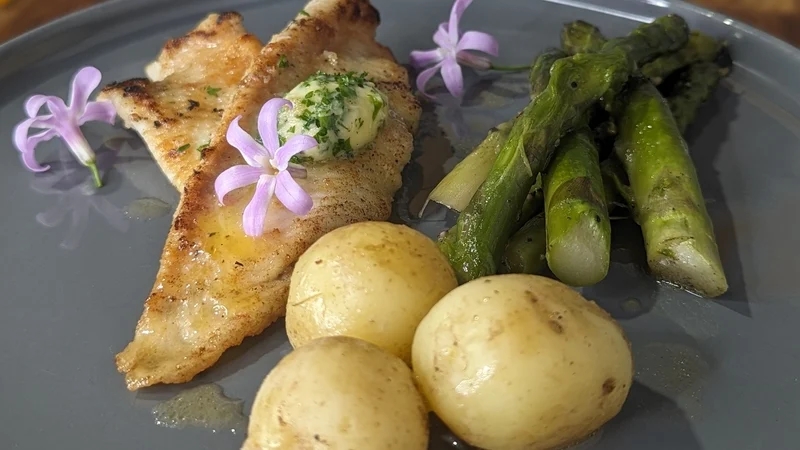
Rachel Allen’s pan-fried fish with herb butter, asparagus, new potatoes.
Ingredients
Serves: 4-6
For the herb butter:
50g soft butter
1 tablespoon chopped herbs such as dill, fennel, chives, parsley
A squeeze of lemon juice
Salt and pepper
For the pan-fried fish:
4 fillets of flat fish, such as John Dory, plaice, sole, brill or turbot, or part of a round fish fillet, like salmon, cod, grey mullet, etc. (allow 175g for a main course and 75g for a starter)
Approximately 4 tablespoons flour
Extra virgin olive oil or soft butter
A pinch of sea salt flakes and freshly ground black pepper
Method
Dry the fish fillets on kitchen paper.
Season on both sides with sea salt flakes and freshly ground black pepper.
Heat a cast iron or non-stick frying pan on a high heat until smoking. Add a dash of olive oil and put in the fish fillets.
OR you can dust the fillets with seasoned flour then spread some soft butter over one side.
Place buttered side in the pan first. Turn when golden on one side, then cook again until golden on the other side.
Place a couple of slices of herb butter over each fillet and serve immediately with asparagus and boiled new potatoes.
Serves six.
You will need:
6 x 175g (6oz) pieces of haddock
Salt and freshly ground black pepper
225g (8oz) Irish mature Cheddar cheese, grated
1 tablespoon Dijon mustard
4 tablespoons cream
Ovenproof dish 8½ x 10 in (21.5 x 25.5cm)
Pre-heat the oven to 180°C, 350°F, Gas 4.
First season the haddock pieces with the salt and freshly ground black pepper. Arrange the fillets in a single layer in the ovenproof dish (it should be a dish that is posh enough to bring to the table). Mix the grated Cheddar cheese together with the Dijon mustard and the cream and spread carefully over the fish.
The fish can be prepared ahead and refrigerated at this point. It will keep in the fridge for a day.
To cook, place in the pre-heated oven for about 20 minutes or until the fish is cooked and the top is golden and bubbly. If the fish is cooked but the top is not yet golden, place under a hot grill for just a few moments to colour the cheese.