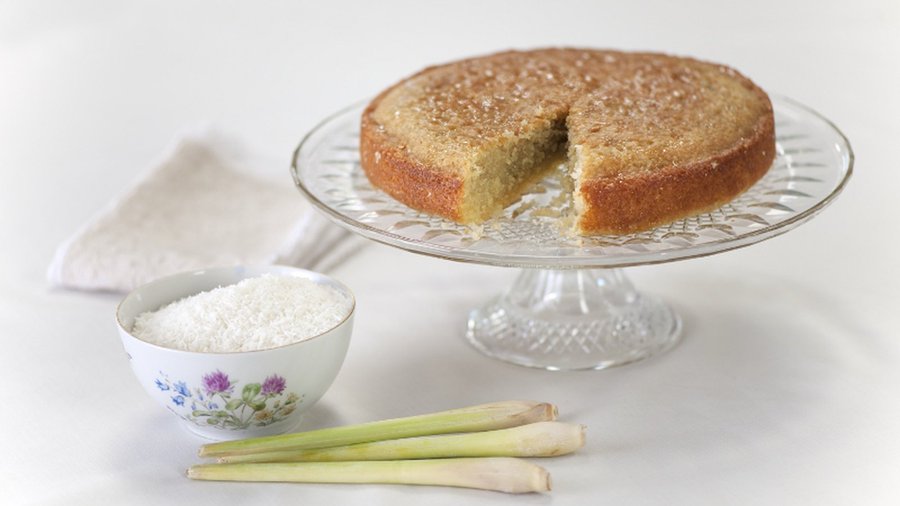
Lemongrass Coconut Cake by Rachel Allen @Ballymaloe


By Rachel Allen Celebrity Chef
More from
Rachel Allen’s Cake Diaries


A quirky combination. The end result? A scrumptious cake for all to enjoy.
Ingredients
4 stalks of lemongrass, base and tops trimmed, outer leaves removed but reserved for the syrup (see below)
250 g (9oz) caster sugar
4 eggs
200 g (7oz) butter, softened, plus extra for greasing
125 g (41/2 oz) desiccated coconut
125 g (41/2 oz) plain flour, plus extra for dusting
2 tsp baking powder
greek yoghurt or creme fraiche, to serve
for the syrup
reserved trimmings and outer leaves of the lemongrass (see above)
75 g (3oz) caster sugar
23cm (9in) diameter cake tin with 6cm
Method
Preheat the oven to 170°C (325°F/Gas 3). Butter the sides of the cake tin and dust with flour, then line the base with a disc of baking parchment.
Slice the lemongrass stalks quite thinly into rounds about 3mm (1?8in) thick, then place in a food processor with the caster sugar and whiz for 1–2 minutes or until the lemongrass is finely puréed and very aromatic.
Add the eggs, butter and coconut and whiz again until combined, then sift the flour and baking powder together and add to the machine, whizzing very briefly just until the ingredients come together.
Tip the mixture into the prepared tin and bake for 40–45 minutes or until a skewer inserted into the centre of the cake comes out clean. While the cake is cooking, make the syrup.
Roughly chop the lemongrass trimmings, place in a saucepan with the sugar and 75ml (3fl oz) of water and set over a high heat. Stir the mixture until the sugar is dissolved, then bring to the boil and boil for 2 minutes before removing from the heat and leaving to infuse.
When the cake has finished baking, take it out of the oven and let it sit in the tin for 10 minutes. Loosen around the edges using a small, sharp knife and carefully remove the cake from the tin before transferring to a serving plate.
Reheat the syrup, then pierce holes all over the cake with a skewer and pour the hot syrup through a sieve onto the cake, moving the pan and sieve around as you pour so that the syrup covers the top of the cake. Allow the cake to cool down completely.
Serve with a dollop of natural Greek yoghurt or crème fraiche.

Japanese milk bread – Shokupan @rachelallencooks #Ballymaloe

rachelallencooks's profile picture

rachelallencooks

Verified

ballymaloecookeryschool's profile picture

Liked by 

ballymaloecookeryschool and others

  • rachelallencooks's profile picturerachelallencooksVerifiedHappy Homemade Bread Day 🍞

    Japanese milk bread – Shokupan

    This is a Japanese tear-and-share loaf of bread with the most wonderful pillowy soft texture. It’s inspired by the Yudane and Tangzhong method where a little bit of flour and water or milk (both in this case) are cooked together to make a white sauce before mixing in the remaining ingredients. This method pre-gelatinises the starch in the flour allowing it to absorb more liquid, giving you a super-light loaf that stays fresh for longer as it retains the moisture.

    It also is divine with cinnamon, cardamom,dried fruit and/or candied peel added as a sweet treat.

    Here’s the recipe 👇🏽 below in Comments in 2 parts! Happy baking 🧡

    This bread can be made so easily using a Thermomix @thermomixukandireland too!Edited · 3h
  • rachelallencooks's profile picturerachelallencooksVerifiedThis quantity will make one 23 cm tear-and-share loaf.

    50g water
    50g milk
    15g strong white flour

    375g strong white flour
    15g milk powder
    25g caster sugar
    1 teaspoon salt
    115g milk
    1 egg, beaten
    25g fresh yeast or 12g dried yeast
    50g butter, melted

    Pour the water and the milk into a small saucepan and bring to the boil. Add in the 15g of flour & cook, whisking all the time, over the heat for a couple of minutes until the liquid has thickened to a white sauce. Tip the white sauce into a bowl & cool.
    Place the 375g of strong white flour in a mixing bowl, or the bowl of an electric food mixer (with the dough hook attached) ) with the milk powder, the sugar & the salt, & mix.
    Now place the milk in a separate bowl & add in the beaten egg, the yeast,the melted butter & the white sauce. Stir then pour all of this liquid into the dry ingredients & mix to a dough. Knead for 8-10 minutes by hand or in the machine until you have a smooth and almost springy dough, don’t add flour while you’re kneading, the dough is supposed to be slightly sticky. When I’m using a stand mixer for this I scrape down the sides of the bowl a couple of times during kneading.
    When the dough has been kneaded enough it will be smooth on the outside. Press it with a floured finger and the dent that you make with your finger should spring back a little bit.
    Place the dough into a bowl that’s large enough to take the dough when doubled in size (or leave it in the stand mixer bowl) & cover the bowl with a clean tea towel or a plate. Place it somewhere warm, not above 45’C, or just standing on the counter in your kitchen and allow the dough to double in size, this may take 2 hours. If you wish you can place the covered bowl of dough in the fridge overnight.
    When the dough has doubled in size, using a floured fist, punch the dough down to knock it back then knead it for just 1 minute.
    Brush a 23cm spring-form tin with melted butter, then dust with flour.
    Divide the dough into 8 equal pieces, each weighing about 90g. Keep all dough covered with a clean tea towel while you work with one ball of dough. On a very lightly floured work surface, place one ball of dough.2 likesReply
  • rachelallencooks's profile picturerachelallencooksVerifiedOn a very lightly floured work surface, place one ball of dough. Fold the edges, all the way round, into the centre of the ball of dough, squashing it down in the centre as you go. Turn the ball over so that the folded side is on the underside and the smooth side is on top. Roll the ball gently under the palm of your hand to make a round roll then place into the prepared tin. Repeat with all the other balls of dough so that you end up with 7 around the sides, spaced apart, and one ball in the centre. Now cover with the tea towel again and place on the worktop or somewhere a little warmer, again not above 45’C , and allow to rise again until almost doubled in size, about 35-45 minutes.

    Preheat an oven to 200’C. The dough is ready when you make a little dent with a floured finger and it doesn’t spring back. Also, the balls of dough should have joined together at this stage. Whisk the egg with a pinch of salt and brush very gently over the top of the risen bread. Place the bread in the lower part of the preheated oven to bake for 30-40 minutes. The dough, out of the tin, should sound hollow when you tap it on the base. If you wish you can bake the bread out of the tin for the last 5 minutes of cooking time. Place on a wire rack to cool.2 likesReply
  • leanwithlesleyLooks delicious, reminds me of your ciabatta/tabata 😂❤️Reply
  • View replies (1)