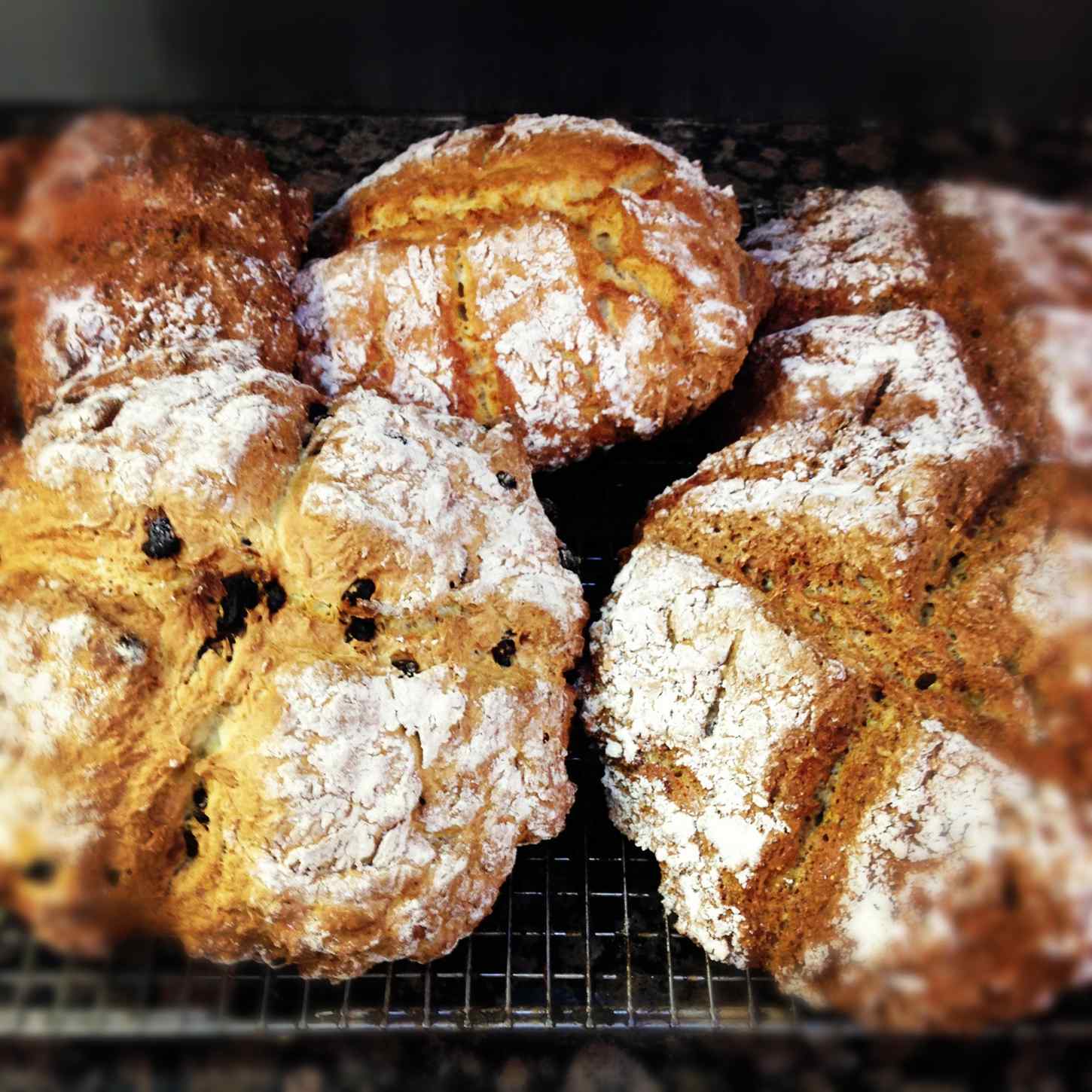
450g (1lb, 31/2 cups) plain flour 1/2 teaspoon sugar 1/2 teaspoon salt 1/2 teaspoon bicarbonate of soda 300-600ml (1/2 – 1 pint, 1 1/4 – 2 1/2 cups) sour milk or buttermilk
METHOD
Sieve the dry ingredients. Make a well in the centre.
Pour in all the milk at once. Using 1 hand, with your fingers stiff and outstretched like a claw, stir in a full circular movement from the centre to the outside of the bowl in ever increasing circles. The dough should be softish, not too wet and sticky. When it all comes together, turn it out onto a well-floured work surface. Wash and dry your hands. Tidy it up and flip over gently. Pat the dough into a round, about 4cm deep.
Cut a deep cross on the loaf and prick in the four corners.
Bake in the oven for 15 minutes then turn down to 200deg C for 30 minutes until cooked. If you are in doubt, tap the bottom of the bread, when it is cooked it will sound hollow. Cool on a wire rack.
Tip! Soda breads are best eaten on the day they are made, but are still good the next day.
Spotted Dog
Follow the recipe above adding: 1 dessert spoon of sugar, 100g sultanas, 1 egg.
Add the sugar and the sultanas with the flour and drop the egg in with the milk before missing. Spotted dog is also called railway cake in some parts of Ireland.
Stripy Cat
Follow the spotted dog recipe replacing the sultanas with 75g of roughly chopped best quality chocolate.
Come to savour culinary delights at Ballymaloe House Hotel.BOOK YOUR STAY
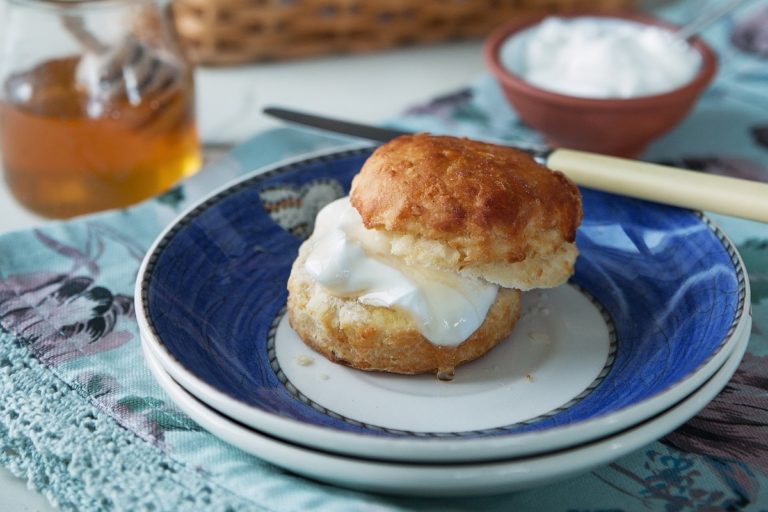
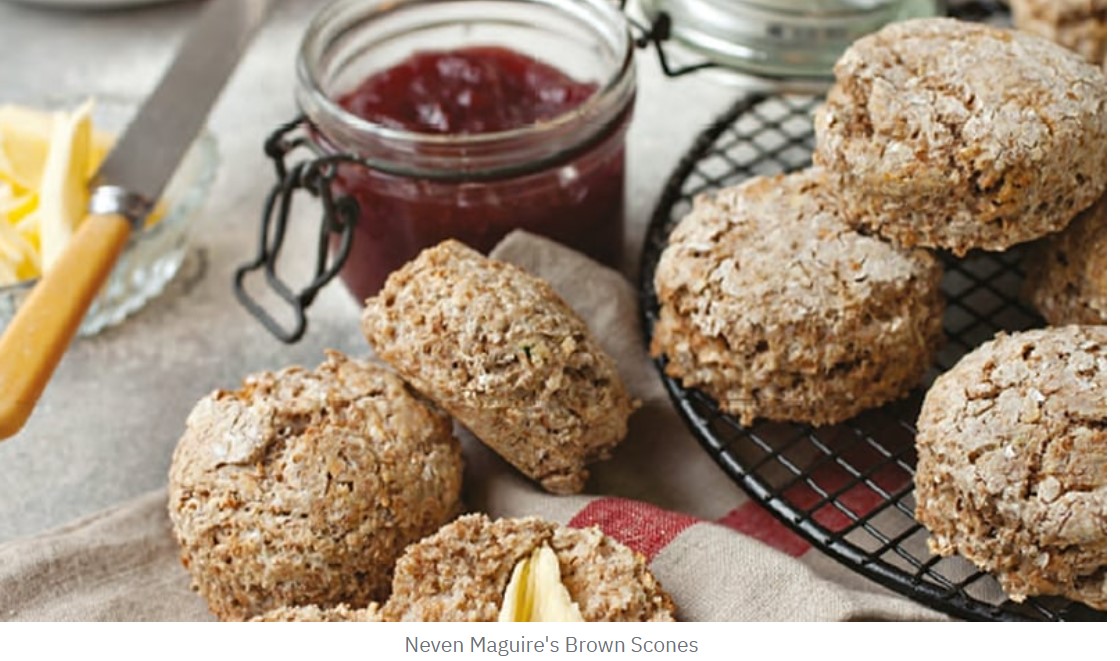
Brown scones are full of roughage and great for breakfast. And here is a good tip: you can make this mixture, shape the scones and freeze them. You can then cook the scones straight from the freezer to the oven – just give them an extra 5 minutes and make sure the scones are golden brown and well-risen.
Ingredients
Rapeseed or sunflower oil, for greasing
225g (8oz) self-raising flour, plus extra for dusting
225g (8oz) coarse wholemeal flour
½ tsp baking soda
½ tsp salt
50g (2oz) wheat bran
25g (1oz) butter, diced and at room temperature
1 tsp light muscovado sugar
300ml (½ pint) buttermilk, plus a little extra if necessary
Method
Preheat the oven to 220°C (425°F/gas mark 7). Line 2 baking sheets with parchment paper and grease the paper with a little oil.
Sift the flours, baking soda and salt into a bowl. Tip in the bran left in the sieve and stir it in with the wheat bran. Rub in the butter with your fingertips until it is evenly dispersed. Stir in the sugar.
Make a well in the centre of the dry ingredients and add the buttermilk and golden syrup. Using a large spoon, mix gently and quickly until you have achieved a smooth, not-too-sticky dough. Add a little more buttermilk if necessary, until the dough binds together without being sloppy.
On a lightly floured surface, roll out the dough to a 2.5cm (1in) thickness and cut into rounds with a 6cm (2½in) plain cutter. Arrange on the lined baking sheets and bake for 10-15 minutes, until golden brown and well-risen.
Serve with butter or lightly whipped cream and strawberry jam.
Start yours and your baby’s day off right with these delicious and super nutritious breakfast muffins. Made using wholesome ingredients like carrots, apples, sunflower seeds, Greek yogurt and wholemeal flour, these muffins are the perfect breakfast finger food for your little one to enjoy in the morning.
To serve to babies – Ensure you are always sitting with your baby when they are eating. Serve a mini muffin with a side of fruit. I like to use sliced pear, mango or strawberries.
For older children serve 2 mini muffins or 1 large muffin in their lunchbox.
These muffins are perfect for school as they contain no sugar whatsoever!
The only sweetness comes from the delicious apple. You can make them even sweeter by adding a mashed banana to the mixture. @babyledfeeding
I am never quite sure if I should be calling this a cake or a tart but in any event, it is delicious and quite easy to make.
Ingredients
I am never quite sure if I should be calling this a cake or a tart but in any event, it is delicious and quite easy to make.
The origins of the recipe are from Tuscany in Italy but I like to use highly perfumed Irish dessert apples when in season. Look out for some lesser known but very delicious Irish dessert apples such as Irish Peach and Ardcairn Russet.
Serves 8
10g butter melted for greasing the parchment paper
4 dessert apples
Finely grated zest of 2 lemons
1 teaspoon vanilla extract
250g caster sugar
2 eggs
150ml cream
110g butter melted and cooled
125g whole almonds, blanched, peeled and ground to a fine powder in a food processer or ground almonds
110g plain flour sieved
1 ½ teaspoons baking powder sieved
100g of apricot jam
1 tablespoon lemon juice, warmed and sieved
2 tablespoons of chopped sweet geranium leaves ( optional)
Method
Preheat the oven to 180c / 350 f / gas 4
Line a 28cm flan ring with a removable base with a disc of parchment paper. The paper should in one piece cover the base and sides of the tin and come up 1cm above the edge of the tin. Brush the paper with a little melted butter.
Peel, core and quarter the apples and slice into c 3mm slices. Mix with the lemon zest. Whisk the vanilla, sugar, and eggs to a thick and light consistency similar to a batter. Whisk in the cream and cooled melted butter. Fold in the almonds, flour and baking powder. Add ¾ of the sliced apples, being careful not to break the apple slices.
Pour the mixture into the prepared flan ring and gently smooth over the surface. Scatter the remaining apples over the surface and sprinkle with 1 dessertspoon of caster sugar.
Place in the preheated oven and cook for 20 minutes. Reduce the temperature to 160c etc and cook for a further 40 minutes by which time the tart will feel gently set. It may be necessary to cover the tart during the cooking with a sheet of parchment paper if the tart is getting too dark.
Remove from the oven and allow to cool slightly. While the tart is still warm, Paint the surfaced with the warm sieved apricot jam to achieve a glossy glaze and if using the chopped geranium, sprinkle on immediately after glazing the tart.
Rachel shares the recipe for her mouth-watering Cookies and Cream Cheesecake from her show Rachel Allen’s Everyday Kitchen
Ingredients
For the double chocolate chip cookies
makes 20 large cookies
225 g (8oz) butter, softened
325 g (111/2oz) caster sugar
2 eggs
1 tsp vanilla extract
225 g (8oz) plain flour
75 g (3oz) cocoa powder
1 tsp bicarbonate of soda
1/4 tsp salt
175 g (6oz) dark chocolate (55–70% cocoa solids), chopped into small pieces, or dark chocolate chips
For the cheesecake
15 g (1/2oz) cocoa powder, sifted
25 ml (1fl oz) strong coffee, such as espresso
1 tsp vanilla extract
500 g (1lb 2oz) mascarpone
400 ml (14fl oz) double or regular cream
50 g (2oz) icing sugar
50 g (2oz) dark chocolate (55–75% cocoa solids), grated, for sprinkling
9-12 of the double chocolate chip cookies
23cm (9in) diameter spring-form cake tin
Method
Place the butter in a large bowl and beat until very soft. Add the sugar and beat until the mixture is pale and fluffy. Crack in one egg at a time, beating between each addition, then add the vanilla extract. Sift in the flour, cocoa powder, bicarbonate of soda and salt, then add the chocolate pieces/chips and fold in to combine. Alternatively, place all the ingredients except the chocolate pieces/chips in a food processor and whiz briefly until they come together, then fold in the chocolate.
With wet hands, form the dough into balls each the size of a golf ball (or use two soup spoons to scoop up and shape the same amount of dough). Arrange on the prepared baking sheets, placing 6–7 balls of dough on each sheet and leaving space for the cookies to spread.
Bake for 10–14 minutes or until the cookies look slightly cracked on top. (With three baking sheets, you will need to cook them in three batches, or two batches in a fan oven.) Take out of the oven and allow to cool for a few minutes, then remove from the baking sheets using a palette knife or metal fish slice and place on a wire rack to cool down completely.
In a large bowl, whisk together the cocoa powder, coffee, vanilla extract, mascarpone, cream and icing sugar for 1–2 minutes or until thick.
Arrange one-third (3–4) of the cookies in the bottom of the cake tin, then spread over one-third of the chocolate cream mixture. Add a second layer of cookies, then another layer of chocolate cream, followed by a final layer of cookies and a final layer of chocolate cream.
Use a spatula to smooth the top layer of chocolate cream, then cover the tin with cling film and place in the fridge to chill for eight hours or overnight.
To remove the cheesecake from the cake tin, run a small, sharp knife around the cheesecake to loosen the edges, then unfasten the clip and lift away the sides of the tin. Using a palette knife or a metal fish slice, loosen the cheesecake from the base of the tin and carefully slide off onto a plate. Sprinkle with the grated chocolate to serve.
Start yours and your baby’s day off right with these delicious and super nutritious breakfast muffins. Made using wholesome ingredients like carrots, apples, sunflower seeds, Greek yogurt and wholemeal flour, these muffins are the perfect breakfast finger food for your little one to enjoy in the morning.
To serve to babies – Ensure you are always sitting with your baby when they are eating. Serve a mini muffin with a side of fruit. I like to use sliced pear, mango or strawberries.
For older children serve 2 mini muffins or 1 large muffin in their lunchbox.
These muffins are perfect for school as they contain no sugar whatsoever!
The only sweetness comes from the delicious apple. You can make them even sweeter by adding a mashed banana to the mixture. @babyledfeeding





 Foodaware