
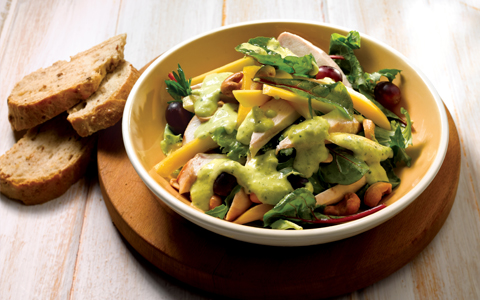
Chicken Salad Bowl with Avocado & Chickpeas @bordbia #workingmums
Nutrition key to sound health

Place the sliced potatoes into a pan of boiling water and cook for 5 minutes, drain and leave until needed.
In a large frying pan add the olive oil and butter and cook the sliced mushrooms until soft, approximately 5 minutes. While the mushrooms are cooking preheat your grill to medium.
In a bowl lightly whisk the eggs, cream, parsley and a little seasoning.
Pop the potatoes into the pan with the mushrooms, arrange so the pan is evenly covered. Pour in the egg mixture and cook over a very low heat until the egg is setting around the edge, pop under the grill and continue to cook until set.
For more delicious and healthy potato recipes visit www.potato.ie/recipes/
Pastry
Filling
Custard
To make the pastry: Sift the flour and icing sugar into a bowl. Using a round-bladed knife or the tips of your fingers, work in the butter and then mix in the egg yolks. Add the ice-cold water until the dough just comes together. Wrap in cling film and chill for at least 30 minutes.
Preheat the oven to 190°C (375°F/gas mark 5). Lightly dust the work surface with flour.
Divide the pastry into 2 portions, one slightly larger than the other, then roll out the larger piece until it is about 30cm in diameter. Use to line a 20cm pie dish or a 23cm flat plate, gently pressing into the corners. Trim the edges with a knife and reserve the excess for decorating. Place back in the fridge to chill while you prepare the apples.
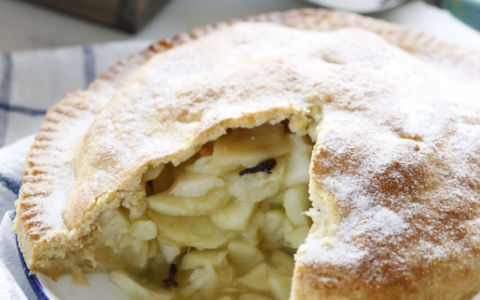
Peel, core and slice the apples. Place in a large bowl with all but 1 tablespoon of the caster sugar. Add the cinnamon and cloves and mix together. Brush the edge of the pastry with a little milk and then pile the apples into the lined pie dish. Roll out the second piece of pastry into a circle slightly larger than the pie dish and use to cover the apples. Press the edges together to seal, then use a sharp knife to cut away any excess.
Crimp the edges of the tart with a round-bladed knife, using your fingers as a guide. If you wish roll out the pastry scraps and cut into leaf shapes. Brush the shapes with milk and stick on top of the pie. Brush the entire top of the pastry with milk and sprinkle over the remaining 1 tablespoon of sugar. Bake for 25-30 minutes, then reduce the oven to 180°C (350°F/gas mark 4) and bake for another 20-25 minutes, until golden brown.
Meanwhile, to make the custard, place the egg yolks in a large bowl with the sugar and vanilla seeds. Whisk with an electric mixer for a few minutes, until pale and thickened.
Place the milk and cream in a medium pan and bring to the boil, then immediately remove from the heat. Gradually whisk the heated milk and cream into the egg yolk mixture until smooth, then pour back into the pan and place over a gently heat. Cook gently for 6-8 minutes on a medium heat, stirring constantly, until the custard coats the back of a wooden spoon. Keep warm.
To serve, cut the warm apple tart into slices and arrange on warmed serving places with some of the custard. Pour the remaining custard into a jug and hand around separately.
http://www.bordbia.ie/consumer/recipes/desserts/pages/appletartwithcustard.aspx

This way of cooking fish is perceived as being rather old fashioned, but if you have a really fresh fish, it can be fabulous and quite contemporary in its simplicity. Hake, cod, ling and mackerel are all delicious cooked in this way. The relish served here is classic, and when properly prepared, it will remind you why herbs, butter and lemon will always have a place at the table when fresh fish is being served.
To cook the fish, place the grill pan on a medium heat and allow to become quite hot. You don’t want it smoking madly, but should see a light haze, almost like vapour, arising from the pan. Dry the fish fillets with paper towel and dip in the seasoned flour and shake off the excess. You can skip this flouring stage if you wish. With a knife, lightly butter the flesh side of the fish fillets. Place the fish, buttered sides down on the hot grill. The fish should sizzle immediately it hits the pan, if it doesn’t, the pan wasn’t hot enough and you need to crank up the heat immediately. If you have difficulty determining if the pan is hot enough, take one of the pieces of fish and holding it above the pan, just place a corner of the buttered side onto the grill. If it sizzles, it is fine to proceed, if it doesn’t then allow the pan to get hotter. Let the fish cook, still on a high heat until the fish is well coloured. There should be a bit of smoke coming from the pan, but not great clouds of it, so adjust the heat accordingly. Lift the fish at one corner to check if it is golden and getting crisp. When you are confident this stage has been reached, turn the heat down a little and with the help of a fish or egg slice, turn the fish over on to the skin side. Let it continue to cook until the skin is crispy and the fish is cooked through. You will know the fish is cooked when the flesh appears to be white and creamy in colour and no longer looks translucent.
While the fish is cooking, melt the butter for the relish. Allow the butter to cool a little before stirring in the chopped herbs.
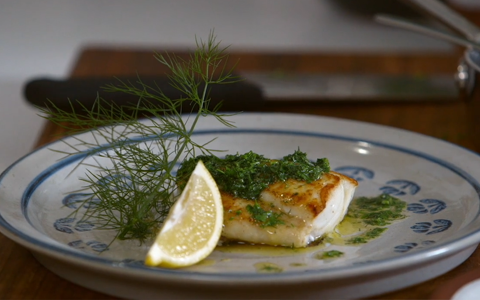
Remove the cooked fish to hot serving plates, placing them with the golden flesh side up. Place a wedge of lemon on each plate and drizzle the herb relish over.
If you wish garnish with a spring of parsley and serve immediately.
http://www.bordbia.ie/consumer/recipes/roryoconnell/pages/grilledfishwithherbrelish.aspx
This way of cooking fish is perceived as being rather old fashioned, but if you have a really fresh fish, it can be fabulous and quite contemporary in its simplicity. Hake, cod, ling and mackerel are all delicious cooked in this way. The relish served here is classic, and when properly prepared, it will remind you why herbs, butter and lemon will always have a place at the table when fresh fish is being served.
To cook the fish, place the grill pan on a medium heat and allow to become quite hot. You don’t want it smoking madly, but should see a light haze, almost like vapour, arising from the pan. Dry the fish fillets with paper towel and dip in the seasoned flour and shake off the excess. You can skip this flouring stage if you wish. With a knife, lightly butter the flesh side of the fish fillets. Place the fish, buttered sides down on the hot grill. The fish should sizzle immediately it hits the pan, if it doesn’t, the pan wasn’t hot enough and you need to crank up the heat immediately. If you have difficulty determining if the pan is hot enough, take one of the pieces of fish and holding it above the pan, just place a corner of the buttered side onto the grill. If it sizzles, it is fine to proceed, if it doesn’t then allow the pan to get hotter. Let the fish cook, still on a high heat until the fish is well coloured. There should be a bit of smoke coming from the pan, but not great clouds of it, so adjust the heat accordingly. Lift the fish at one corner to check if it is golden and getting crisp. When you are confident this stage has been reached, turn the heat down a little and with the help of a fish or egg slice, turn the fish over on to the skin side. Let it continue to cook until the skin is crispy and the fish is cooked through. You will know the fish is cooked when the flesh appears to be white and creamy in colour and no longer looks translucent.
While the fish is cooking, melt the butter for the relish. Allow the butter to cool a little before stirring in the chopped herbs.
Remove the cooked fish to hot serving plates, placing them with the golden flesh side up. Place a wedge of lemon on each plate and drizzle the herb relish over.
If you wish garnish with a spring of parsley and serve immediately.
http://www.bordbia.ie/consumer/recipes/roryoconnell/pages/grilledfishwithherbrelish.aspx
Tomato and Red Onion Salad
Pea and Potato Mash
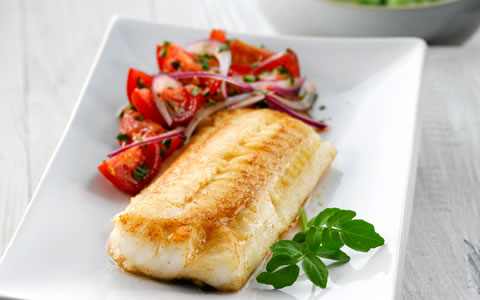
Heat a little olive oil in a large frying pan. Season the fish and add to the pan, skin side up. Fry for 3-4 minutes then turn it over. Add a knob of butter to the pan and continue to cook the fish for another 3-4 minutes until it flakes easily with a fork. As the butter melts spoon it over the fish.
Meanwhile combine the salad ingredients. Taste for seasoning.
Heat the milk and butter in a saucepan then combine with the cooked potatoes and peas. Mash well. Season to taste.
Serve the fish with the Tomato and Red Onion Salad and Pea and Potato Mash.
Protein: 41g
Carbohydrates: 48g
Fat: 19g
Iron: 2mg
Energy: 522kcal
http://www.bordbia.ie/consumer/recipes/fish/pages/panfriedwhiting-tomatoandredonionsalad.aspx

