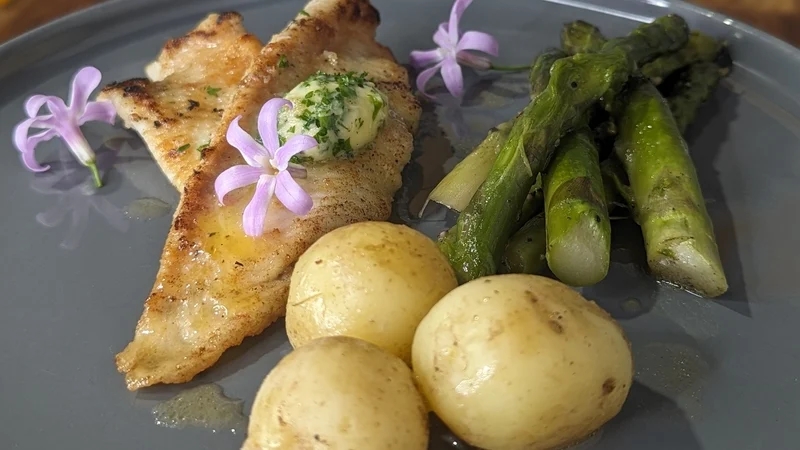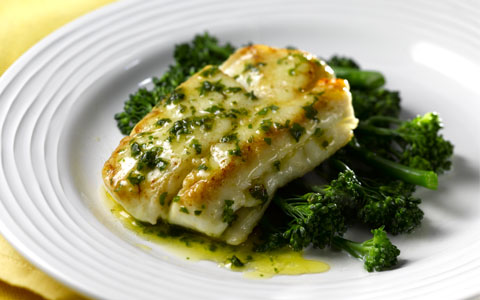
Rachel Allen’s pan-fried fish with herb butter, asparagus, new potatoes.
Ingredients
Serves: 4-6
For the herb butter:
50g soft butter
1 tablespoon chopped herbs such as dill, fennel, chives, parsley
A squeeze of lemon juice
Salt and pepper
For the pan-fried fish:
4 fillets of flat fish, such as John Dory, plaice, sole, brill or turbot, or part of a round fish fillet, like salmon, cod, grey mullet, etc. (allow 175g for a main course and 75g for a starter)
Approximately 4 tablespoons flour
Extra virgin olive oil or soft butter
A pinch of sea salt flakes and freshly ground black pepper
Method
Dry the fish fillets on kitchen paper.
Season on both sides with sea salt flakes and freshly ground black pepper.
Heat a cast iron or non-stick frying pan on a high heat until smoking. Add a dash of olive oil and put in the fish fillets.
OR you can dust the fillets with seasoned flour then spread some soft butter over one side.
Place buttered side in the pan first. Turn when golden on one side, then cook again until golden on the other side.
Place a couple of slices of herb butter over each fillet and serve immediately with asparagus and boiled new potatoes.
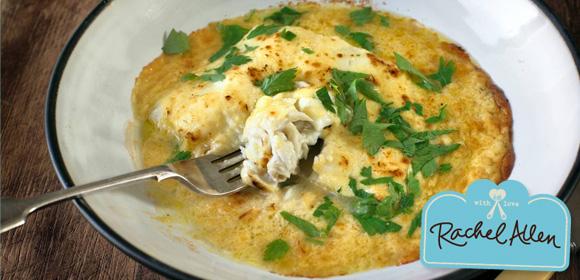
First season the haddock pieces with the salt and freshly ground black pepper. Arrange the fillets in a single layer in the ovenproof dish (it should be a dish that is posh enough to bring to the table). Mix the grated Cheddar cheese together with the Dijon mustard and the cream and spread carefully over the fish.
The fish can be prepared ahead and refrigerated at this point. It will keep in the fridge for a day.
To cook, place in the pre-heated oven for about 20 minutes or until the fish is cooked and the top is golden and bubbly. If the fish is cooked but the top is not yet golden, place under a hot grill for just a few moments to colour the cheese.
Of course this recipe is great with just parsley but experiment with a combination of soft fragrant herbs sauce as parsley, chives, tarragon or chervil depending on what’s available.
Serves 4
Ingredients
4 x 175g hake fillets, skin on and boned
1 tablesp. olive oil
Salt and freshly ground pepper
50g butter
½ lemon, pips removed
1 tablesp. chopped mixed herbs (parsley, chives and tarragon)
To Cook
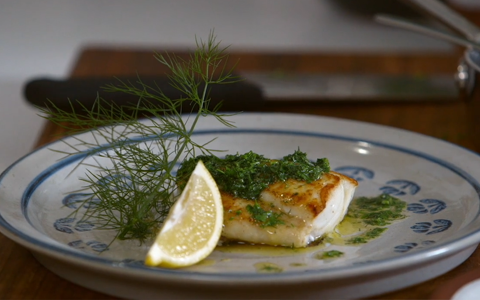
Heat the olive oil in a large frying pan and add the seasoned hake fillets, skin side down. Cook for a couple of minutes until the skin is just beginning to crisp, then add little knobs of butter to the pan around each hake fillet and cook for another couple of minutes until the skin is crisp.
Turn the hake fillets over and cook for another 3-4 minutes until cooked through. This will depend on the thickness of the fillets. Transfer to warmed plates while you make the sauce.
Add the rest of the butter to the frying pan and allow it to gently melt over a moderate heat. When it has melted, add a squeeze of lemon juice and the herbs, swirling to combine. Season to taste. Spoon this sauce over the hake fillets and serve with steamed broccoli and some sautéed new potatoes.
Serving Suggestions
Steamed broccoli and sauté new potatoes
Tips
Above all be careful not to overcook the fish. To check, gently prod the thickest part of the fish with a small knife. If it is cooked, the flesh will look opaque and the flakes will separate easily. If it isn’t done yet, it will still have the translucent look for raw fish.
Other fish you could use: Whiting, haddock or trout fillets
This way of cooking fish is perceived as being rather old fashioned, but if you have a really fresh fish, it can be fabulous and quite contemporary in its simplicity. Hake, cod, ling and mackerel are all delicious cooked in this way. The relish served here is classic, and when properly prepared, it will remind you why herbs, butter and lemon will always have a place at the table when fresh fish is being served.
Serves 4
4 x 120- 150g pieces of your fish of choice
2 tablespoons of flour, seasoned with salt and pepper optional
25 g butter at room temperature
salt and pepper
4 wedges of lemon
Herb Relish
50g butter
2 tablespoons of very finely chopped herbs such as parsley, chives, fennel and a few thyme leaves
black pepper
To cook the fish, place the grill pan on a medium heat and allow to become quite hot. You don’t want it smoking madly, but should see a light haze, almost like vapour, arising from the pan. Dry the fish fillets with paper towel and dip in the seasoned flour and shake off the excess. You can skip this flouring stage if you wish. With a knife, lightly butter the flesh side of the fish fillets. Place the fish, buttered sides down on the hot grill. The fish should sizzle immediately it hits the pan, if it doesn’t, the pan wasn’t hot enough and you need to crank up the heat immediately. If you have difficulty determining if the pan is hot enough, take one of the pieces of fish and holding it above the pan, just place a corner of the buttered side onto the grill. If it sizzles, it is fine to proceed, if it doesn’t then allow the pan to get hotter. Let the fish cook, still on a high heat until the fish is well coloured. There should be a bit of smoke coming from the pan, but not great clouds of it, so adjust the heat accordingly. Lift the fish at one corner to check if it is golden and getting crisp. When you are confident this stage has been reached, turn the heat down a little and with the help of a fish or egg slice, turn the fish over on to the skin side. Let it continue to cook until the skin is crispy and the fish is cooked through. You will know the fish is cooked when the flesh appears to be white and creamy in colour and no longer looks translucent.
While the fish is cooking, melt the butter for the relish. Allow the butter to cool a little before stirring in the chopped herbs.
Remove the cooked fish to hot serving plates, placing them with the golden flesh side up. Place a wedge of lemon on each plate and drizzle the herb relish over.
If you wish garnish with a spring of parsley and serve immediately.
Rachel Allen’s pan-fried fish with herb butter, asparagus, new potatoes.
Ingredients
Serves: 4-6
For the herb butter:
50g soft butter
1 tablespoon chopped herbs such as dill, fennel, chives, parsley
A squeeze of lemon juice
Salt and pepper
For the pan-fried fish:
4 fillets of flat fish, such as John Dory, plaice, sole, brill or turbot, or part of a round fish fillet, like salmon, cod, grey mullet, etc. (allow 175g for a main course and 75g for a starter)
Approximately 4 tablespoons flour
Extra virgin olive oil or soft butter
A pinch of sea salt flakes and freshly ground black pepper
Method
Dry the fish fillets on kitchen paper.
Season on both sides with sea salt flakes and freshly ground black pepper.
Heat a cast iron or non-stick frying pan on a high heat until smoking. Add a dash of olive oil and put in the fish fillets.
OR you can dust the fillets with seasoned flour then spread some soft butter over one side.
Place buttered side in the pan first. Turn when golden on one side, then cook again until golden on the other side.
Place a couple of slices of herb butter over each fillet and serve immediately with asparagus and boiled new potatoes.
This creamy, cheesy version of the baked egg classic swaps in sweet potatoes.
Ingredients
Chefs Yotam Ottolenghi and Noor Murad admit this dish is “a far cry from a classic shakshuka, yes, but we’ve found that sweet potatoes provide just the right amount of moisture and heft to serve as a base for these eggs.
“Serve this vibrant dish as a weekend brunch; it sure looks the part,” they suggest.
1kg sweet potatoes, skin on and scrubbed clean 1 small red onion, thinly sliced into rounds 2tbsp lemon juice 3tbsp olive oil 150g mature cheddar, roughly grated 3 garlic cloves, crushed 1tsp cumin seeds, roughly crushed with a pestle and mortar 8 medium eggs 25g unsalted butter ¾tbsp sriracha 2tbsp picked fresh coriander leaves, with some stem attached Salt and black pepper
(Elena Heatherwick/PA)
Method
1. Preheat the oven to 200°C fan. Poke the sweet potatoes all over with a fork (about eight to 10 times) and place them on a medium, parchment-lined baking tray. Bake for 45–50 minutes, or until cooked through and softened. Set aside to cool and turn the oven temperature down to 180°C fan.
2. Meanwhile, in a small bowl mix together the onion, one tablespoon of lemon juice and a pinch of salt and set aside to pickle.
3. Remove the cooked potato skins and tear them into roughly 4cm pieces. Transfer the potato flesh to a large bowl and set aside. Place the skins back on the baking tray and toss with one tablespoon of oil, a quarter teaspoon of salt and a good grind of pepper. Bake for eight minutes, or until nicely coloured and starting to crisp up. Set aside to cool and crisp up further.
4. Use a fork to mash the potato flesh until smooth, then add the cheddar, garlic, cumin, another tablespoon of oil, the remaining tablespoon of lemon juice, one teaspoon of salt and a generous grind of pepper, and mix to combine.
5. Put the remaining tablespoon of oil into a large frying pan, for which you have a lid, and swirl around to coat the bottom. Spoon the mashed potato mixture into the pan, using your spoon to distribute it evenly. Place on a medium-high heat and leave to cook for about seven minutes, for the bottom to start to colour. Turn the heat down to medium and use a spoon to make eight wells in the potato mixture, breaking an egg into each. Sprinkle lightly with salt and pepper, cover with the lid and cook for four to five minutes, rotating the pan, or until the whites are set and the yolks are still runny.
6. While the eggs are cooking, put the butter and sriracha into a small saucepan on a medium heat and cook until the butter has melted, whisking constantly to emulsify. Remove the mixture from the heat before it starts to bubble – you don’t want it to split.
7. When ready, spoon the sriracha butter all over the eggs, then top with a good handful of the crispy potato skins, half the pickled onion and all the picked coriander leaves. Serve right away, with the rest of the potato skins and pickled onion to eat alongside.
Ottolenghi Test Kitchen: Shelf Love by Noor Murad and Yotam Ottolenghi, photography by Elena Heatherwick, is pubished by Ebury Press.
Serves six.
You will need:
6 x 175g (6oz) pieces of haddock
Salt and freshly ground black pepper
225g (8oz) Irish mature Cheddar cheese, grated
1 tablespoon Dijon mustard
4 tablespoons cream
Ovenproof dish 8½ x 10 in (21.5 x 25.5cm)
Pre-heat the oven to 180°C, 350°F, Gas 4.
First season the haddock pieces with the salt and freshly ground black pepper. Arrange the fillets in a single layer in the ovenproof dish (it should be a dish that is posh enough to bring to the table). Mix the grated Cheddar cheese together with the Dijon mustard and the cream and spread carefully over the fish.
The fish can be prepared ahead and refrigerated at this point. It will keep in the fridge for a day.
To cook, place in the pre-heated oven for about 20 minutes or until the fish is cooked and the top is golden and bubbly. If the fish is cooked but the top is not yet golden, place under a hot grill for just a few moments to colour the cheese.