Put the tofu, ground star anise, vanilla seeds, treacle and agave syrup into a large bowl and blend with a hand blender until silky smooth.
Melt the chocolate in a heatproof glass bowl sat over a saucepan of simmering water, being careful not to let the bowl touch the water. Fold into the tofu. Spoon the mixture between 4 glasses and refrigerate until set.
To make the honeycomb, line a baking tray with baking paper. Put the sugar, glucose and golden syrup into a deep saucepan and heat until it reaches 145C. (This should take about 5 minutes). Quickly whisk in the bicarbonate of soda. Be careful as the mixture will bubble up very suddenly. Quickly pour onto the lined baking tray. Set aside to cool and harden.
To make the apricots, heat the oil in a frying pan. Add the apricots and star anise and cook until the apricots start to caramelise. Sprinkle over a pinch of sugar and leave to cool.
To serve, sprinkle the toasted almonds on top of the mousse and serve with the apricots and peices of honeycomb.
½ vanilla pod, split in half and seeds scraped out
300ml milk
100ml cream
To Cook
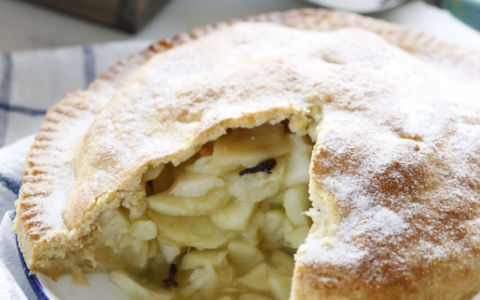
To make the pastry: Sift the flour and icing sugar into a bowl. Using a round-bladed knife or the tips of your fingers, work in the butter and then mix in the egg yolks. Add the ice-cold water until the dough just comes together. Wrap in cling film and chill for at least 30 minutes.
Preheat the oven to 190°C (375°F/gas mark 5). Lightly dust the work surface with flour.
Divide the pastry into 2 portions, one slightly larger than the other, then roll out the larger piece until it is about 30cm in diameter. Use to line a 20cm pie dish or a 23cm flat plate, gently pressing into the corners. Trim the edges with a knife and reserve the excess for decorating. Place back in the fridge to chill while you prepare the apples.
Peel, core and slice the apples. Place in a large bowl with all but 1 tablespoon of the caster sugar. Add the cinnamon and cloves and mix together. Brush the edge of the pastry with a little milk and then pile the apples into the lined pie dish. Roll out the second piece of pastry into a circle slightly larger than the pie dish and use to cover the apples. Press the edges together to seal, then use a sharp knife to cut away any excess.
Crimp the edges of the tart with a round-bladed knife, using your fingers as a guide. If you wish roll out the pastry scraps and cut into leaf shapes. Brush the shapes with milk and stick on top of the pie. Brush the entire top of the pastry with milk and sprinkle over the remaining 1 tablespoon of sugar. Bake for 25-30 minutes, then reduce the oven to 180°C (350°F/gas mark 4) and bake for another 20-25 minutes, until golden brown.
Meanwhile, to make the custard, place the egg yolks in a large bowl with the sugar and vanilla seeds. Whisk with an electric mixer for a few minutes, until pale and thickened.
Place the milk and cream in a medium pan and bring to the boil, then immediately remove from the heat. Gradually whisk the heated milk and cream into the egg yolk mixture until smooth, then pour back into the pan and place over a gently heat. Cook gently for 6-8 minutes on a medium heat, stirring constantly, until the custard coats the back of a wooden spoon. Keep warm.
Serving Suggestions
To serve, cut the warm apple tart into slices and arrange on warmed serving places with some of the custard. Pour the remaining custard into a jug and hand around separately.
Watch How to Cook Well with Rory O’Connell at 8:30pm on Tuesday evenings on RTÉ One. Ingredients A classic lemon posset or set cream is a simple and lovely thing and my version here with blackberries and sweet geranium leaves is I believe a good and delicious variation on the theme. It is remarkable how easy this is and how without the aid of egg or gelatine, the mixture sets into a tender chilled pudding. I like the possets served straight from the fridge, so nice and chilly. I often make this during the winter months using wild blackberries that I have frozen in the late summer or early autumn. If you are using frozen berries, use them straight from the freezer. I never cease to be amazed by the value one gets from a few bags of frozen fruit when fresh local fruit is simply not an option due to the seasons. A little softly whipped cream is the perfect accompaniment along with a fresh organic or crystallised rose petal. The combination of rose and blackberry is a marriage made in heaven and I might be tempted to add a few drops of rose water to the cream when whipping. Be careful though as too much rose water will yield a flavour that is too strong and overpowering. The flavour of the rosewater cream should be akin to catching the scent of a rose while walking about the garden – there but almost illusive. If you do not have the lemon or rose-scented geranium, you can just leave it out. The fragrant leaves do however bring a magical element to the dish. The plants are easily found at good garden centres and can be treated as a house plant living on a bright window-sill or if the weather is mild where you live, they can spend spring, summer and autumn out of doors in a sheltered sunny spot. I can’t imagine not having one of these plants for the ravishing flavour to bring to certain dishes. In fact, it is the sort of magic that one receives from this rather innocuous looking leaf that humbles and mesmerises me and reminds me every time I use it, how astonishing nature is and how fortunate that my career has brought me down this path where I handle these treasures all of the time. Oh, joy. The possets can be served in little cups or glasses or the prettiest receptacle you like to use. The portions are quite small as this is quite a rich little dish but I always think it is better to be longing for one more spoonful rather than being faced with too much food. A thin lacy biscuit such as the Nougatine biscuits would also be good here and I might be tempted to add a few drops of rose water to the cream when whipping. Serves 8 400ml cream 90g caster sugar 5 leaves of rose or lemon scented geranium 100g blackberries 50ml lemon juice. Method Place the cream, sugar, geranium leaves and blackberries in a small saucepan and bring to a bare simmer. Stir the saucepan occasionally to encourage the sugar to dissolve. Maintain that bare simmer for 5 minutes. If the cream boils hard the texture and consistency of the posset will be spoiled. Remove the saucepan from the heat and stir in the lemon juice. You will notice the colour of the cream improving dramatically as soon as the lemon juice goes in. Now strain the cream through a sieve to remove the geranium leaves and at the same time push as much of the blackberries through as possible. Pour the strained cream into 8 little cups or glasses and allow to cool before placing in the fridge for 3 hours to set. The posset will keep perfectly in your fridge for several days. I like to cover them to protect the delicate flavour. Serve with a little softly whipped cream and if you have them, a fresh or crystallised rose petal and a nougatine biscuit.
1 packet of shortcrust pastrythawed if bought frozen
1 tbsp flour
1 eggbeaten
Handful flaked almonds
Directions
1
Place raspberries in a medium sized bowl then sprinkled over caster sugar and squeeze over some lemon juice. Stir with a fork so that some of the raspberries are broken up, but still maintaining plenty of whole ones. Set aside.
2
Pre-heat the oven to 200°C / 180°C fan assisted and place a flat baking sheet or overturned tray in the oven to pre-heat.
3
Roll out chilled shortcrust pastry on a floured surface to about 5mm thick then transfer to a baking tray lined with parchment paper. Using a sharp knife, cut the pastry into a large heart, discarding the trimmed pieces of pastry.
4
Sprinkle the flour over the middle of the pastry, this will help thicken the juices while baking, then tip out the raspberries on top and spread out over the pastry in an even layer, but keep a 4-5cm border around the edges.
5
Fold the pastry border up and over the filling, shaping the galette into a heart as you fold the edges over, until you’re back where you started, crimping the pastry together where the folds meet to help them stick.
6
Brush the pastry border with beaten egg and sprinkle with flaked almonds.
7
Place the tray directly on top of the hot tray already in the oven and bake until pastry is golden, 30-35 minutes.
8
Remove from the oven and leave to stand for about 5-10 minutes before serving with scoops of ice-cream or dollops of whipped cream while still warm.
The name of this simple dessert comes from the Italian tirami su, meaning ‘pick me up’ (or ‘cheer me up’). Tiramisu has been subjected to many variations over the years, but this is the original recipe and – in my opinion – the best! This is a dessert that actually benefits from being made ahead, allowing the lovely flavours to mingle. As a result, it is perfect for a large gathering.
Serves 8–10
4 large eggs
100g caster sugar
250g mascarpone cheese 2
50ml cream
250ml freshly brewed strong espresso coffee (left to cool completely)
150ml Tia Maria or Kahlúa liqueur
40 sponge fingers
50g bar plain chocolate
2 tsp cocoa powder
Separate the eggs, putting the yolks in one bowl with 80g of the sugar, and the egg whites in another. Using an electric beater, whisk the egg yolks and sugar until pale and creamy, then mix in the mascarpone cheese until well combined. Whip the cream in a separate bowl until soft peaks form, then fold into the egg yolk and mascarpone mixture.
Using spotlessly clean beaters, whisk the egg whites with 20g of sugar until soft peaks form, then fold this into the mascarpone cream. Spoon a third of this mixture into a suitable dish that is at least 2cm deep. Pour the coffee into a shallow dish and stir in the Tia Maria or Kahlúa. Dip in enough of the sponge fingers to make an even layer on top of the mascarpone mixture. Only dip the sponge fingers in as you go along, so they don’t soak for too long and become difficult to handle.
Cover the layer of soaked sponge fingers with another third of the mascarpone mixture, then grate most of the chocolate bar on top using the coarse side of a grater. Add another layer with the rest of the soaked sponge fingers, then spoon over the remaining mascarpone mixture and spread evenly with a back of a spoon. Cover with cling film and chill overnight to allow the flavours to develop and the dessert to settle. To serve, give the tiramisu a good dusting of cocoa powder, then grate over the rest of the chocolate. Place in the middle of the table so that everyone can help themselves.
SERVE AFTER … A go-to dessert if you like spoiling your guests after a long Italian-inspired meal. Tiramisu is ideal for the warmer months since it can be made well in advance and kept in the fridge until needed.
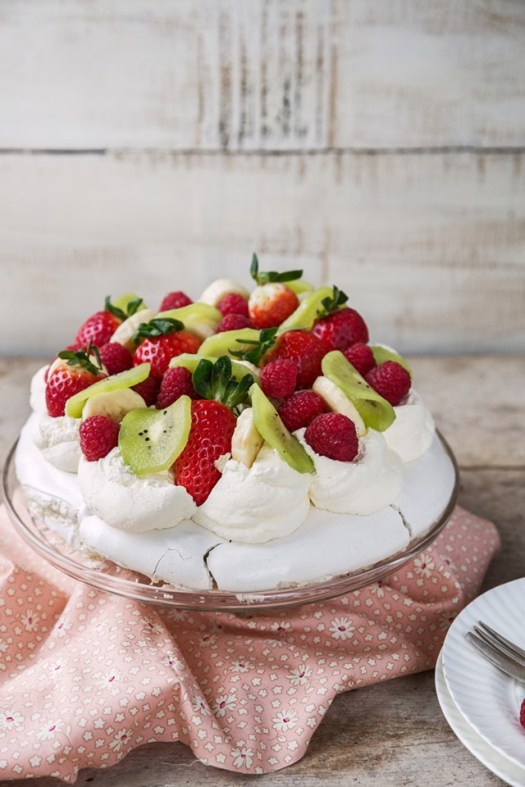
Pavlova Wreath with Exotic Fruit
Cakes are always the sweet option of choice for birthdays and anniversaries. However, I would like to introduce to you the Pavlova Wreath – it is very pretty and easy to make, and it delivers an incredible flavour. As always, feel free to use your own favourite combination of flavours to personalise it. Be sure to produce it with a flourish for that ‘ta-da’ moment!
Serves 10–12
For the meringue
5 egg whites
250g caster sugar
50g icing sugar
2 tsp cornflour
For the raspberry sauce
200g raspberries
2 tbsp icing sugar
1 tbsp lime juice
2 tsp cornflour or arrowroot
For the crème Chantilly
200ml cream (well chilled)
1 tsp vanilla extract
40g icing sugar
To decorate
200g raspberries
400g tin lychees, well drained and cut in half
2 passion fruit, halved and seeds scooped out
Preheat the oven to 140°C (275°F/Gas Mark 1). Put the egg whites into the bowl of a stand mixer. Turn on to a medium speed and whisk until they begin to go frothy and hold their shape a little. Mix the caster and icing sugar together, then add about one third to the eggs in a steady stream, whisking all the time on medium to high. The mixture will now begin to thicken a little.
Make sure that all the sugar has dissolved before you add any more. Add the next third and repeat the process, whisking it all up well. Then add the final third of the sugar. Whisk on high now, since the egg mixture will be much more stable. Keep whisking until you reach the stiff-peak stage. Add the cornflour and fold in with a spoon. Draw a 25cm circle on a piece of parchment paper and use it to line a large baking sheet, then draw a 10cm circle in the middle. This is your stencil. Put dollops of the meringue mixture on to the wreath stencil, keeping it within the edges.
Bake for 55–60 minutes until the meringue has just a little colour. Remove it from the oven and leave to cool. Meanwhile, make the raspberry sauce. Blitz the raspberries in a food processor with the icing sugar and lime juice, then pass through a sieve into a small pan using a plastic spatula. Mix the cornflour or arrowroot with one tablespoon of water until smooth, then add this to the raspberries. Bring to the boil over medium to high heat, then simmer gently for a few minutes until thickened, stirring occasionally.
Set aside to cool. For the crème Chantilly, whisk up the cream, vanilla and sugar in a bowl until it is just beginning to hold soft peaks. Cover with cling film and chill until needed. Carefully slide your Pavlova wreath on to a large, flat serving plate. Place dollops of the crème Chantilly around the top of the wreath, then drizzle over some of the raspberry sauce; the rest can be served in a jug at the table. Decorate the wreath with the raspberries, lychees and passion fruit pulp. Serve straight away.
I am never quite sure if I should be calling this a cake or a tart but in any event, it is delicious and quite easy to make.
Ingredients
I am never quite sure if I should be calling this a cake or a tart but in any event, it is delicious and quite easy to make.
The origins of the recipe are from Tuscany in Italy but I like to use highly perfumed Irish dessert apples when in season. Look out for some lesser known but very delicious Irish dessert apples such as Irish Peach and Ardcairn Russet.
Serves 8
10g butter melted for greasing the parchment paper
4 dessert apples
Finely grated zest of 2 lemons
1 teaspoon vanilla extract
250g caster sugar
2 eggs
150ml cream
110g butter melted and cooled
125g whole almonds, blanched, peeled and ground to a fine powder in a food processer or ground almonds
110g plain flour sieved
1 ½ teaspoons baking powder sieved
100g of apricot jam
1 tablespoon lemon juice, warmed and sieved
2 tablespoons of chopped sweet geranium leaves ( optional)
Method
Preheat the oven to 180c / 350 f / gas 4
Line a 28cm flan ring with a removable base with a disc of parchment paper. The paper should in one piece cover the base and sides of the tin and come up 1cm above the edge of the tin. Brush the paper with a little melted butter.
Peel, core and quarter the apples and slice into c 3mm slices. Mix with the lemon zest. Whisk the vanilla, sugar, and eggs to a thick and light consistency similar to a batter. Whisk in the cream and cooled melted butter. Fold in the almonds, flour and baking powder. Add ¾ of the sliced apples, being careful not to break the apple slices.
Pour the mixture into the prepared flan ring and gently smooth over the surface. Scatter the remaining apples over the surface and sprinkle with 1 dessertspoon of caster sugar.
Place in the preheated oven and cook for 20 minutes. Reduce the temperature to 160c etc and cook for a further 40 minutes by which time the tart will feel gently set. It may be necessary to cover the tart during the cooking with a sheet of parchment paper if the tart is getting too dark.
Remove from the oven and allow to cool slightly. While the tart is still warm, Paint the surfaced with the warm sieved apricot jam to achieve a glossy glaze and if using the chopped geranium, sprinkle on immediately after glazing the tart.
Put the tofu, ground star anise, vanilla seeds, treacle and agave syrup into a large bowl and blend with a hand blender until silky smooth.
Melt the chocolate in a heatproof glass bowl sat over a saucepan of simmering water, being careful not to let the bowl touch the water. Fold into the tofu. Spoon the mixture between 4 glasses and refrigerate until set.
To make the honeycomb, line a baking tray with baking paper. Put the sugar, glucose and golden syrup into a deep saucepan and heat until it reaches 145C. (This should take about 5 minutes). Quickly whisk in the bicarbonate of soda. Be careful as the mixture will bubble up very suddenly. Quickly pour onto the lined baking tray. Set aside to cool and harden.
To make the apricots, heat the oil in a frying pan. Add the apricots and star anise and cook until the apricots start to caramelise. Sprinkle over a pinch of sugar and leave to cool.
To serve, sprinkle the toasted almonds on top of the mousse and serve with the apricots and peices of honeycomb.