Keeling’s Blackberry & Goat’s Cheese Quiche

Screenshot_2020-05-25 Blackberry Goat’s Cheese Quiche Keelings

Blackberry & Goat’s Cheese Quiche

Ingredients

Ready to roll shortcrust pastry, thawed if frozen

6 eggs

100 ml milk

100 g sour cream

120 g goat’s cheese

80 g blackberries, cut in halves

2 tsp fresh thyme leaves

Salt & pepper

Directions

1Pre-heat oven to 180°C/160°C fan assisted.

2Gently roll the shortcrust pastry out over a 20cm loose-bottomed quiche tin. Press pastry into the tin and then trim away excess pastry. Chill in the freezer for about 10 minutes.

3In a large bowl or jug, whisk together eggs, milk, sour cream and a generous pinch of salt and pepper.

4Slice goat’s cheese then cut each slice into quarters.

5Pour egg mixture into chilled pastry then evenly distribute the goat’s cheese and halved blackberries. Sprinkle with thyme leaves.

6Carefully transfer to the preheated oven and bake for 30-35 minutes, until quiche is set around the edges and has lost its glossy top but there’s a slight wiggle in the centre.

7Leave to cool for about 15 minutes before enjoying warm. Can also be served cold

https://keelings.ie/recipes/blackberry-goats-cheese-quiche/

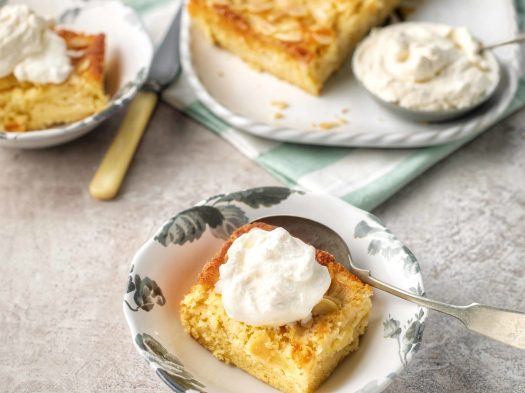
Rory O’Connell’s Tuscan Apple, Lemon & Almond Cake


Food on RTÉ

@RTEfood
·


Crisp on top and full of plump, juicy apples, this Tuscan tart is simply delicious.

By Rory O’Connell

Celebrity Chef

I am never quite sure if I should be calling this a cake or a tart but in any event, it is delicious and quite easy to make.

Ingredients

I am never quite sure if I should be calling this a cake or a tart but in any event, it is delicious and quite easy to make.

The origins of the recipe are from Tuscany in Italy but I like to use highly perfumed Irish dessert apples when in season. Look out for some lesser known but very delicious Irish dessert apples such as Irish Peach and Ardcairn Russet. 
 
Serves
 

  • 10g butter melted for greasing the parchment paper 
  • 4 dessert apples 
  • Finely grated zest of 2 lemons 
  • 1 teaspoon vanilla extract 
  • 250g caster sugar 
  • 2 eggs 
  • 150ml cream 
  • 110g butter melted and cooled 
  • 125g whole almonds, blanched, peeled and ground to a fine powder in a food processer or ground almonds 
  • 110g plain flour sieved 
  • 1 ½ teaspoons baking powder sieved 
  •  100g of apricot jam 
  • 1 tablespoon lemon juice, warmed and sieved 
  •  2 tablespoons of chopped sweet geranium leaves ( optional) 

Method

  1. Preheat the oven to 180c / 350 f / gas 4 
  2. Line a 28cm flan ring with a removable base with a disc of parchment paper. The paper should in one piece cover the base and sides of the tin and come up 1cm above the edge of the tin. Brush the paper with a little melted butter.
  3. Peel, core and quarter the apples and slice into c 3mm slices. Mix with the lemon zest. Whisk the vanilla, sugar, and eggs to a thick and light consistency similar to a batter. Whisk in the cream and cooled melted butter. Fold in the almonds, flour and baking powder. Add ¾ of the sliced apples, being careful not to break the apple slices.
  4. Pour the mixture into the prepared flan ring and gently smooth over the surface. Scatter the remaining apples over the surface and sprinkle with 1 dessertspoon of caster sugar.
  5. Place in the preheated oven and cook for 20 minutes. Reduce the temperature to 160c etc and cook for a further 40 minutes by which time the tart will feel gently set. It may be necessary to cover the tart during the cooking with a sheet of parchment paper if the tart is getting too dark.
  6. Remove from the oven and allow to cool slightly. While the tart is still warm, Paint the surfaced with the warm sieved apricot jam to achieve a glossy glaze and if using the chopped geranium, sprinkle on immediately after glazing the tart. 
  7.  Serve warm with softly whipped cream. 

Molly Malone’s cockle and mussel chowder

molly malones chowder

Molly Malone was a beautiful girl who sold cockles and mussels and died tragically of a fever while still young, or so the song goes. Molly may not have been a real girl, but since at least the 17th century, there have been fishmongers on the streets of Dublin who sell ‘Cockles and Mussels, alive, alive, oh!’

Cockles, with their distinctive flavour and lovely curved shell, are traditionally eaten in Ireland with Oatcakes. If you can only find mussels, this chowder will be just as good.

Serve either as a substantial starter or with chunks of crusty bread as a meal in its own right.

Heat the sunflower oil in a saucepan over medium-high heat. Add the bacon and sauté for about 1 minute, until crisp and golden. Add the butter to the pan and melt. Then add the leek, carrot and potato. Reduce the heat to low and sauté gently for 4–5 minutes, until soft but not browned.

Meanwhile, prepare the cockles and mussels. Scrub the shells clean and discard any that remain open when you tap them against a hard surface. Remove the beard – the little fibrous tuft – from each mussel. Bring the wine to a boil in a large saucepan and add the cockles and mussels. Cover with a tight-fi tting lid and cook for 3–4 minutes, shaking the pan occasionally, until the shells have opened.

Remove from the heat, drain the shellfi sh in a colander, reserving the cooking juices, and discard any shells that remain closed. Return the shellfi sh to the empty pan to keep warm. Place a fine sieve over a measuring jug and strain the cooking liquid. You should have at least 600ml (1 pint); if not, add water to make up that quantity.

Add the pan juices and the milk to the bacon and vegetable mixture and bring to a boil. Reduce the heat and simmer for 6–8 minutes, until the potato is tender. Add the cream and simmer for another 2–3 minutes, until the soup is reduced and thickened slightly. Season with salt and pepper.

Meanwhile, remove half of the cockles and mussels from their shells and add them with the remaining cockles and mussels still in their shells to the chowder. Stir in the parsley and serve at once.

http://www.rachelallen.com/post/molly-malones-cockle-and-mussel-chowder